The Handshake
Part of the cognition series. Builds on The Natural Framework and General Intelligence. This post is the formal backbone of the series. It’s dense by design. The Parts Bin is where the formalism becomes practical. The formalism has a companion Lean 4 proof.
Claim
The six roles are not a metaphor. They have a natural home in category theory: morphisms inside a monad, constrained by the data processing inequality. The Natural Framework derives all six from temporal flow and bounded storage: three by existence proof at the boundaries, three more by corollary. Five compose forward as stages. The sixth, Consolidate, reads from Transmit and writes to the substrate. This post formalizes the composition: contracts, budget, and the inductive argument for survival.
Category
Objects are measurable spaces (information states). Morphisms are Markov kernels (stochastic maps). This is the Kleisli category of the Giry monad, the category Stoch (Fritz 2020).
The Giry monad G is the endofunctor. It maps measurable spaces to spaces of probability distributions. η (unit) is the Dirac delta: a deterministic state is a special case of a probabilistic one. μ (join) is integration: averaging over uncertainty about uncertainty yields uncertainty.
The six roles compose as morphisms inside this monad. Five compose forward. Consolidate runs backward through the substrate, reshaping parameters from outcome to cause. The individual roles don’t need to be endofunctors. They need to be structure-preserving morphisms.
Contracts
Not all morphisms are equal. Each role carries a postcondition, a structural guarantee on the output:
| Role | Type | Guarantee |
|---|---|---|
| Perceive | raw → encoded | Parseable by next stage. Injects new bits. |
| Cache | encoded → indexed | Retrievable by key. Atomic under concurrent read/write (Perceive writes while Filter reads). |
| Filter | indexed → selected | Strictly smaller. Losers suppressed, winners forwarded. |
| Attend | (policy, selected) → ranked | Ordered, diverse, bounded. Survivors are dissimilar. |
| Transmit | ranked → persisted | Retrievable on next cycle's Perceive. Also caches ranked output for Consolidate. |
| Consolidate | persisted → policy′ | Backward pass. Reads from Transmit asynchronously, writes to the substrate. Lossy. Reshapes how each stage processes. |
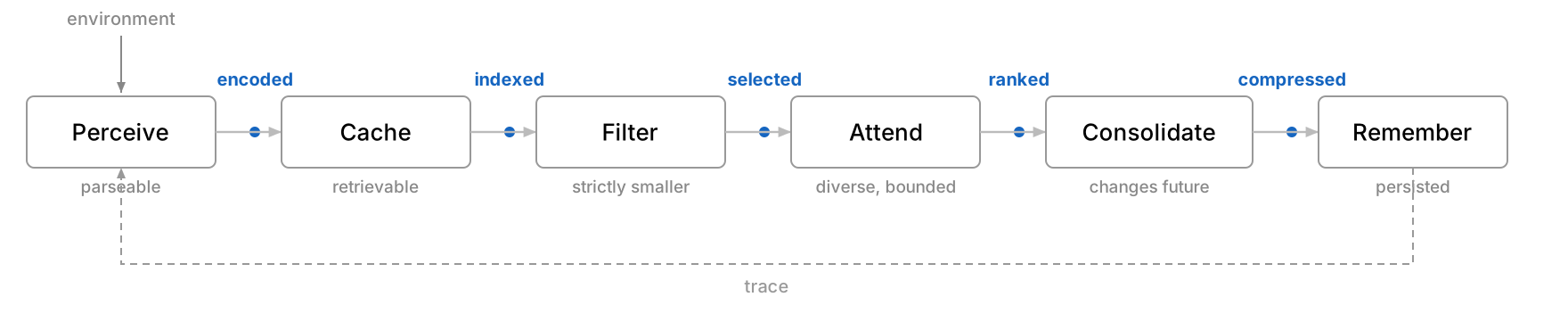
A morphism that preserves its contract through composition is contract-preserving. It belongs in the pipeline. One that doesn’t is an arbitrary self-map. It breaks downstream. (In the proof: Contract, ContractPreserving, IterationStable.)
Compaction reorganizes a cache but guarantees nothing about future processing. Consolidation guarantees the system changes. Wrong morphism type, same slot.
The contracts encode a second axis: which store. Perceive, Cache, Filter, and Transmit operate on the data stream. Attend reads policy from the substrate (Corollary 2). Consolidate writes policy back into the substrate as the backward pass. The separation is derived: if policy shares a pool with data, variance corrupts the governing criterion within one iteration.
Four claims follow from the contracts:
- If contracts match, algorithms are swappable. Interface programming. Defensible now. (
swappable) - If any contract is broken, the loop will die. Necessary condition. By induction on cycle count. (
ContractBroken,broken_propagates) - If all contracts are satisfied with sufficient fidelity, the loop survives. Sufficient condition. That is the budget.
- If an operation degrades its postcondition under iteration, it is a near-miss. The instability argument from Corollary 2 generalizes: any morphism whose postcondition fails under self-composition will break the loop. Iteration stability is the test. (
NearMiss,stable_not_near_miss)
Why this order
The Natural Framework derives six necessary roles. The handshake makes five of them forward stages: each postcondition is the next stage’s precondition. Rearrange and the contracts break.
- Attend before Filter: policy applied to unfiltered input. Signal drowns in volume.
- Filter before Cache: selecting from what hasn’t been stored. No index, no comparison across items.
- Transmit before Attend: persisting before ranking. No selection, no diversity.
Consolidate is not in the forward chain. It reads from Transmit and writes to the substrate, reshaping how each stage processes. The typed interfaces force the forward order. That is the handshake: the postcondition of stage N is the precondition of stage N+1. The name is the proof. The ordering is provably unique: forward_ordering_unique shows the type chain forces each position, and consolidate_has_no_slot shows Consolidate cannot occupy any forward position. The only configuration whose types compose is five canonical forward stages plus one backward pass.
Open problem: type forcing beyond linear pipelines. The Lean proof covers linear composition. Spivak’s operad of wiring diagrams gives the search space of all type-valid wirings for six boxes. If the six postcondition types are pairwise distinct and each box has arity 1, the only valid wiring in a directed typed operad is the chain. The feedback from Consolidate to Perceive is a delay node, not a regular wire. The six contracts are structurally distinct: Cache carries concurrency invariants that Filter’s output doesn’t; Filter is stateless where Attend reads policy; Transmit is durable where Attend is transient; Consolidate emits control where Transmit emits data. Every observed collapse to passthrough (δ=0) dims the downstream cells. No counterexample exists in the twenty-four domains. The operadic proof is not yet written.
Data processing inequality
The order is fixed. The question is whether the ordered pipeline survives iteration. The constraint: for a Markov chain X → Y → Z, mutual information satisfies I(X;Z) ≤ I(X;Y). Each intermediate step can only decrease what downstream knows about the original input. The pipeline is a cascade of such maps.
In the forward pass, Filter and Attend are lossy: each reduces what the output retains about the raw input. Cache and Transmit can be lossless; the forward pipeline’s net loss comes from the competitive core. Consolidate is also lossy, but it reads from Transmit and compresses persisted outcomes into parameter changes. Its loss is a different kind: it discards specifics to keep the rule.
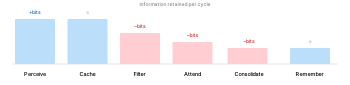
The loop survives only because Perceive injects new bits from the environment. Without new input, a lossy loop compounds information loss per cycle. A closed lossy loop dies (closed_loop_budget_negative). That is the named constraint that makes the budget visible. (In the proof: NonExpanding, StrictlyLossy, non_expanding_compose, InformationBudget.)
A step that fails its contract leaks information faster than Perceive can replenish it. This deficit compounds; the loop degrades. A step that preserves its contract retains signal through each pass. The budget balances; the loop survives.
Iteration-fidelity trade-off
The budget can balance in different ways. Few steps with high retention, or many steps with low retention. The heuristic: step count × per-step fidelity must clear the survival threshold. Diffusion models: a thousand cheap denoising steps, each with a weak guarantee. Human cognition: a few expensive passes. Sleep consolidation is one cycle, deeply lossy, deeply structural.
Fidelity measures retention per pass. Iteration stability is whether the postcondition survives re-application. They are distinct, and they can come apart. Top-k retains most bits but converges to a fixed point: same winners every cycle, diversity dead by cycle two. The loop survives informationally while Attend degrades. That is not starvation. It is homogenization: a different failure mode with a different budget requirement. An iteration-stable operation preserves its postcondition under re-application: sort a sorted list, still sorted. MMR a diverse slate, still diverse. The Parts Bin uses this as the formal test for near-misses.
Rate-distortion theory provides the analogy: each morphism has a distortion cost (bits leaked) and a rate (bits retained). Baez, Fritz, & Leinster (2011) formalized entropy in categorical terms. Connecting it to iterated pipelines is the next step. The framework diagnoses which step is broken. The prescription: strengthen fidelity, or add iterations. Two knobs, one budget.
Biased competition is a morphism
The budget gets spent in the competitive core: Filter, Attend, Consolidate. The mechanism inside that core has a name. Desimone & Duncan (1995) described biased competition: stimuli compete for neural representation, top-down bias resolves the competition. The Natural Framework derives the same separation: control must be independent of data (Corollary 2), stored separately (Corollary 3), and applied through a read interface (Attend). Desimone & Duncan observed it in neurons. The derivation shows it must exist in any bounded selective system.
The formalization came later, piecewise. Reynolds & Heeger (2009) gave a normalization model, Boerlin & Bhatt (2011) gave a spike-coding model. Nobody placed biased competition inside a category.
Filter and Attend are the morphisms that implement biased competition. Filter suppresses losers (guarantee: output strictly smaller). Attend ranks survivors with lateral inhibition (guarantee: winners are dissimilar). One candidate model for the diversity guarantee is the Determinantal Point Process, a probability distribution over subsets that assigns higher weight to diverse selections. DPPs are well-defined probability measures on subsets.
The proposed formalization: define Filter → Attend as a Markov kernel whose output distribution is a DPP over the selected subset. The DPP handles diversity. Ordering and boundedness are additional structure.
DPPs are defined over finite sets, and the set changes each cycle. The iteration-stability objection asks: does the DPP kernel compose stably with itself? It does not need to. If Perceive injects sufficiently novel items into the ground set each cycle, the DPP operates on a genuinely different finite set, not the same set reprocessed. The composition is not DPP ∘ DPP over a fixed set. It is DPP applied to a fresh set drawn from fresh input. Diversity of the input stream is necessary for the DPP postcondition to hold across cycles. It is not sufficient. The DPP kernel is parameterized by a policy that Consolidate writes. If Consolidate degrades, the kernel itself corrupts: Attend receives diverse candidates and selects poorly. Diverse input with a broken selector is a different failure mode than homogeneous input with a working one. Two independent conditions: diverse input and an intact kernel.
This is a stronger claim than the information budget alone. Loop survival requires quantity of new information: enough bits to offset the lossy core. Diversity survival requires two things: variety of new information (enough novel items that the DPP kernel has dissimilar candidates) and an intact policy (a kernel that still repels similar items). An echo chamber violates the first: the loop runs, the budget balances, but the ground set homogenizes until DPP diversity enforcement becomes vacuous. A degraded Consolidate violates the second: diverse input arrives, but the kernel no longer enforces repulsion, so Attend converges on a cluster. Same symptom, independent causes (DiversityBudget, diversity_failures_compatible). This connects to the third death condition: decaying input includes shrinking variety, not only shrinking volume. A broken Consolidate is death condition one applied to the policy pathway.
Three open directions:
- Biased competition as categorical morphism. Formalize Desimone & Duncan’s mechanism as a Markov kernel inside Stoch. Define the kernel, the output space, the conditioning variables.
- DPP as contract. DPPs have been applied to recommendation, summarization, and sampling. Using them as the postcondition of a morphism in a cognitive pipeline, the contract that a step preserves diversity through composition, is a new application.
- Information accounting of competition. Every suppressed loser costs bits. Defining which mutual information, under what coupling, and why subtraction is the right operation. That is the problem.
Trace
Joyal, Street, Verity (1996): traced monoidal categories. The feedback loop (Transmit → Perceive) has the structure of a categorical trace (TracedPipeline): output feeds back as input. The correct typing depends on how environment and internal state interact: what feeds back, what enters from outside, what exits as behavior. Formalizing this requires specifying those components and verifying that the resulting morphism satisfies the trace axioms in Stoch.
In the simpler view: ignore the environment boundary, and the six-step composition is a self-map in Stoch, a Markov chain on information states. But bare Markov chains never worked for cognition: n-grams plateau, PageRank has no taste.
What was missing is attention: a diversity-enforcing morphism that selects and repels. Whether the iterated chain converges, cycles, or diverges depends on conditions (irreducibility, aperiodicity, contractivity) that must be verified per domain. These are the right questions.
Cogito ergo sum: a closed loop with zero new input. A lossy self-map iterated without fresh bits from the environment compounds information loss per cycle. The man in the box goes insane, then dies. It illustrates the framework by failing: the loop structure is intact but the budget is negative.
Falsification test
The trace predicts the closed loop. The falsification test predicts the broken step (removal_tests). Take a known-alive system. Identify a step whose contract was lost. Observe.
| Role replaced | Self-map substituted | System | Outcome |
|---|---|---|---|
| Perceive | Prion — no guarantee on protein encoding | Biology | Death |
| Filter | p53 loss — no guarantee on which cells survive | Biology | Cancer |
| Transmit | Immunosenescence — no guarantee on memory fidelity | Biology | Decay |
| Perceive | Great Leap Forward — falsified harvest data | Society | Famine |
| Filter | TerraUSD — no filter on destabilizing redemptions | Finance | Death spiral |
| Transmit | NASA Columbia — lesson not durably consolidated | Engineering | Catastrophe |
Every case is multi-causal. But in each, a contract was lost, and the loss compounded rather than self-correcting. The vocabulary names the dominant failure mode.
Three death conditions
- Broken step. A morphism loses its contract. Signal leaks faster than Perceive replenishes. (Prion, cancer, TerraUSD.) (
broken_step_death) - Closed loop. Perceive is sealed. Zero credits. (Cogito, frozen weights.) (
closed_loop_zero_input) - Decaying input. Perceive is open but the environment degrades. Credits shrink per cycle. The loop structure is intact, every step preserves its contract, but the source dries up. The system doesn’t break; it starves. (Sensory deprivation, dying ecosystem, echo chamber, agent trained on stale data.) (
decaying_input_death)
The information budget constrains all three: the budget must balance, the credits must exist, and the credits must not decay. The deficit is the diagnosis. The contrapositive — all contracts satisfied and input sustained implies survival — is survival_induction.
Type check
The death conditions apply within a single domain. The next question is whether the structure translates across domains. Eilenberg & Mac Lane (1945): functors preserve composition. If domain A (neurons) and domain B (immune system) both implement six roles with compatible type signatures, the mapping between them is a candidate functor: object map, morphism map, composition preservation. Verifying this requires defining both categories explicitly. The vocabulary makes the translation precise enough to attempt.
Prior art:
- Phillips & Wilson (2010) — categorical cognition, representations not flow
- Coecke (2010) — DisCoCat, syntax → semantics functors, meaning not processing
- Rosen (1991) — (M,R)-systems, biological closure, not pipeline composition
- Spivak (2013) — operad of wiring diagrams, composable modules, not cognitive
- Bradley (2021) — enriched categories of language, probability as hom-objects, semantics not processing
- Desimone & Duncan (1995) — biased competition, empirical mechanism, no math
- Reynolds & Heeger (2009) — normalization model of attention, quantitative but not categorical
The gap: the sequential processing pipeline as morphisms in a Markov category with traced feedback across domains. Representations (Phillips), meaning (Coecke), closure (Rosen), semantics (Bradley), mechanism (Desimone & Duncan). All structure, no flow.
Hard question, answered
Research asks: “construct η and μ explicitly and prove the monad laws.” The Giry monad provides them. Dirac delta and integration. These are well-defined, natural, and have clear information-processing interpretations. The monad laws hold for the Giry monad. This is proven mathematics (Giry 1982).
The six roles are morphisms inside the Giry monad’s Kleisli category. Five compose forward; Consolidate reads from Transmit and writes to the substrate. The composition argument is by induction. Base case: one cycle. Five forward morphisms compose; each postcondition matches the next precondition; Transmit’s output matches Perceive’s input. Consolidate reads persisted outcomes and reshapes parameters for the next cycle.
Inductive step: if cycle n preserves all contracts, cycle n+1 preserves them. The forward contracts are stateless: Filter’s guarantee depends on the input, not on which cycle it is. But Attend reads from the policy store, and Consolidate writes to it. The forward chain at cycle n+1 depends on what the backward pass did at cycle n. The induction requires a coupling lemma:
If Consolidate preserves its contract at cycle n (persisted → policy′ reshapes processing without corrupting the diversity guarantee), then Attend’s precondition is satisfied at cycle n+1.
This is closed. cycle_preserves_policy proves that if Consolidate preserves its postcondition at cycle k, Attend’s precondition holds at k+1. The coupling between Consolidate and Attend is cross-cycle and cross-direction: backward output at n feeds forward input at n+1. The hypothesis hcon — that Consolidate preserves its postcondition — is not a free assumption. The fractal tower derives it.
The fractal tower
Consolidate contains its own pipeline. It reads persisted outcomes, selects which ones to compress into policy updates, and ranks them by relevance. Inner Perceive reads outcomes. Inner Filter selects updates. Inner Attend ranks by relevance. The same six roles, one level down.
The data processing inequality guarantees termination. Filter is strictly lossy: each level costs at least one bit. The bit budget decreases at every depth. At zero bits remaining, Consolidate cannot select — it reduces to passthrough (identity on policy). Passthrough trivially preserves any postcondition.
tower_satisfies_hcon: by induction on depth, the tower preserves the cross-cycle postcondition at every level. Base case: passthrough at depth zero. Inductive step: if the inner tower preserves at depth d, the outer pipeline preserves at depth d+1. This turns hcon from assumption into consequence. The coupling lemma is closed, the induction has no gap, and the framework predicts a specific failure mode: degraded Consolidate corrupts Attend’s kernel even when diverse input arrives (see above).
The derivation in The Natural Framework provides the base case: roles of this shape must exist. The data processing inequality provides the constraint. The falsification test is the contrapositive: replace one contract, observe death.
Objections
“These are just state transformers, not categorical morphisms.” State transformers with no contract are arbitrary self-maps. The distinction between a morphism that preserves postconditions and one that doesn’t is the distinction between a loop that lives and one that dies.
Stoch provides the ambient category: measurable spaces and Markov kernels. The contracts (parseable, retrievable, diverse, etc.) are semantic predicates imposed on top, not structure that Stoch itself encodes. Formalizing them requires further refinement: a subcategory, a fibration, or a logical relation. The vocabulary is precise enough to diagnose. The existence proofs and induction proof are complete. Formalizing the contracts as categorical structure is the remaining work.
“Survival does not prove the monad laws.” Correct. The monad laws hold for the Giry monad independently (Giry 1982). Survival is evidence that the six roles compose well within the monad: the information budget balances. The monad is the container; the roles are the contents.
“The biology/society examples are cherry-picked.” The framework predicts: a singly recursive loop with a broken role is more likely to compound than self-correct, because the broken postcondition feeds a broken precondition on the next cycle.
Every historical failure is multi-causal. The prediction is falsifiable: find a singly recursive loop where a broken contract self-corrects without external repair. The theory was induced from a decade of reflecting posts: observations about teams, organizations, and systems that broke the same way. The math came after, not before.
“Real systems persist first, then compact later. Logs, databases, brains.” Those systems are stacked pipes operating on different types.
A database “persists” a row, but the row is Cache in the larger pipeline. The CRM’s Transmit is the customer relationship, not the database record. A log “persists” events, but that’s Cache for the monitoring pipe. The actual Transmit is the alert rule or the postmortem finding. The brain’s sensory trace “persists” briefly, but that’s Cache. The actual Transmit is consolidated long-term memory. Every “persist first, compact later” example, under analysis, is Cache at one level being confused with Transmit at a higher level. The type mismatch is the tell: if the thing being persisted is a representation rather than the final entity, it’s Cache, not Transmit.
“Consolidate is lossy; Transmit is lossless. How do they relate?” Transmit is the last forward stage: it emits ranked output for the next cycle’s Perceive. Consolidate is the backward pass: it reads from Transmit and writes to the substrate, reshaping how each stage processes. Transmit emits the episode (lossless relative to its input). Consolidate extracts the rule (lossy). Transmit also serves as the cache for Consolidate: ranked outcomes accumulate there, and Consolidate reads them asynchronously. The forward contract on Transmit is “no additional loss.” The backward contract on Consolidate is “reshape how each stage processes.” Timescale is the diagnostic; the contract is the definition.
“Filter and Attend could be one step.” They operate on different stores. Filter gates the data stream: does this item pass the criterion? Attend reads the policy store and applies it: given the survivors, which are worth pursuing? One is per-item admissibility. The other is slate-level ranking with diversity. Merging them conflates “does it pass?” with “how does it relate to everything else that passed?” Those are different questions with different inputs. The Parts Bin catalogs operations for each. The catalogs do not overlap.
Survival over many iterations forces the separation. The stochasticity proof shows Attend must be stochastic: a deterministic selector over a finite state space eventually cycles, diversity dies, the loop dies. Filter requires the opposite: reliable gating, because false positives compound over iterations. Each bad item that passes propagates downstream and is never re-filtered. One function cannot satisfy both contracts across unbounded iterations.
A merged function could internally decompose into a reliable gating phase followed by a stochastic ranking phase. But internal decomposition is role separation. The framework does not require separate executables, only distinct morphisms with distinct contracts.
Harder objection: deterministic cycling could maintain diversity by rotating winners (ABCD, ABCD…). The population argument defeats this. Every system starts as passthrough. A coordinated rotation requires a non-trivial policy that developed from nothing. For a population of functors to arrive at the same rotation, every member must develop the same policy at the same rate. Landauer noise on each development path makes identical trajectories physically impossible. But the deductive proof stops here: convergent attractors, coupling, and inheritance could in principle synchronize a population despite noise. The empirical record closes the gap inductively: no deterministic intelligence exists in nature. Neurons are noisy, evolution is random, immune recombination is stochastic, markets are volatile. Across every domain examined, every system that crossed the threshold to intelligence did it with stochastic selection. The deductive separation of the other five roles is stronger; this one rests on physics plus universal empirical evidence. The deductive closure remains open.
Every interface in the forward pipeline is a handshake. The postcondition of one stage is the precondition of the next. Consolidate reads from Transmit and writes to the substrate, reshaping the stages from outcome to cause. The grip holds in both directions. What remains is to fill the slots.
Proof status
The Lean 4 proof compiles with zero sorry and no Mathlib dependency. Pigeonhole is proved from scratch via element removal. The formalization uses Lean’s stdlib LawfulMonad with a possibilistic Support class that tracks reachability, not probability mass. Morphisms are monadic kernels in a Kleisli category — not measure-theoretic Stoch. The conceptual argument above lives in Stoch (measurable spaces, Markov kernels, the Giry monad). The machine-checked spec lives one level of abstraction higher: any lawful monad whose support satisfies the axioms. The spec checks that the pipeline is internally consistent. The physics and the probability live here, not there.
Continued in The Parts Bin.
Written via the double loop. Lean 4 proof (AGPL-3.0).