Four Bins
Chapter 9 · Milnor 1985, Strogatz 2014, Ramdas 2023
You have the trajectory. It oscillates. Is the system fighting itself, or is your measurement noisy? Chapter 8 gave you e-values that accumulate over time instead of compressing to a scalar. This chapter tells you how to read the shape.
An e-value stream is a time series. "Goes up" is not a diagnosis. "Goes up then down then up" is not a diagnosis either. You need a finite set of trajectory shapes, each mapping to a different kind of system and a different next move. Dynamical systems theory provides exactly four.
Why four and not more
Perturb a system. Watch the response. The trajectory does one of four things:
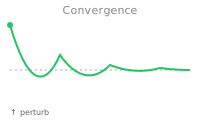
- Convergent. The perturbation decays. The system returns to its previous state. A compensating mechanism absorbed the shock.
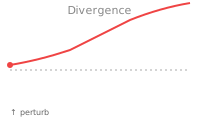
- Divergent. The perturbation grows. The system moves away and keeps going. No compensating mechanism exists.
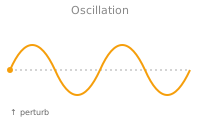
- Oscillatory. The perturbation cycles. Two subsystems push against each other: one compensates, the other overcompensates.
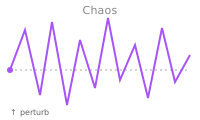
- Chaotic. The trajectory stays bounded but never repeats. Two nearby starting points diverge exponentially. Deterministic but unpredictable past a short horizon.
Milnor (1985) and Strogatz (2014) prove that fixed points, limit cycles, and strange attractors exhaust the attractors of smooth dynamical systems. Applied to finite observed trajectories, the four bins classify evidence behavior, not the true underlying system. A finite trace cannot prove chaos; it can only rule out settling and periodicity within the observed window.
Eigenvalues determine trajectory shape
Linearize the system around an equilibrium point. The Jacobian J has eigenvalues λ, and they determine the bin:
| Eigenvalue type | Trajectory | Mechanism |
|---|---|---|
| All real, all negative | Convergent | Each mode decays exponentially. eλt → 0. |
| Any real, positive | Divergent | At least one mode grows exponentially. eλt → ∞. |
| Complex, negative real part | Damped oscillation (convergent) | Spirals inward. Oscillation decays. |
| Complex, zero real part | Sustained oscillation | Pure rotation. Neither grows nor decays. |
| Complex, positive real part | Divergent oscillation | Spirals outward. Oscillation grows. |
Five rows, three bins: convergent (decay), divergent (growth), oscillatory (rotation). Chaos requires nonlinearity and cannot appear in linear systems. For the fourth bin, you need Lyapunov exponents.
Lyapunov exponents for the nonlinear case
A Lyapunov exponent measures the rate at which two infinitesimally close trajectories diverge or converge. For an n-dimensional system, there are n Lyapunov exponents, one per dimension, ordered largest to smallest: λ1 ≥ λ2 ≥ … ≥ λn.
The largest Lyapunov exponent λ1 determines the bin:
| λ1 | Bin | Meaning |
|---|---|---|
| < 0 | Convergent | Nearby trajectories collapse together. Fixed point. |
| = 0 | Oscillatory | Nearby trajectories stay at constant distance. Limit cycle. |
| > 0, bounded | Chaotic | Nearby trajectories diverge but stay bounded. Strange attractor. |
| > 0, unbounded | Divergent | Trajectories escape to infinity. |
Eigenvalues are the linear case; Lyapunov exponents are the general case. For linear systems they coincide (the Lyapunov exponents are the real parts of the eigenvalues). For nonlinear systems, Lyapunov exponents are all you have. The four bins hold regardless.
Shape prescribes the next experiment
| Bin | Shape | Diagnosis | Next experiment |
|---|---|---|---|
| Convergent | Decays to baseline | Something absorbed the perturbation. Redundancy or compensation. | Test a different node. This node has backup. |
| Divergent | Grows without bound | Critical. No backup. The perturbation cascaded. | Test what depends on it. Map the blast radius. |
| Oscillatory | Periodic cycles | Two subsystems fighting. One pushes, the other pushes back. | Test the interface between them. |
| Chaotic | Bounded, aperiodic | Input exceeds architecture capacity. Too many interacting components for stable behavior. | Decompose differently. Your current partition is too coarse. |
Observe the trajectory, match the shape, read the diagnosis, run the next experiment. Convergent: "this perturbation was absorbed, try a different node." Divergent: "this node matters, dig deeper." Oscillatory: "two things are coupled, find the coupling." Chaotic: "your decomposition is wrong, start over."
def next_experiment(classification, current_node, graph):
    """Given a trajectory classification, return the next experiment."""
    if classification == "convergent":
        # This perturbation was absorbed. Try a different node.
        return graph.least_tested_neighbor(current_node)

    elif classification == "divergent":
        # Load-bearing. Follow its dependencies.
        return graph.most_dependent(current_node)

    elif classification == "oscillatory":
        # Two subsystems fighting. Test the interface.
        return graph.interface_between(
            current_node,
            graph.oscillation_partner(current_node)
        )

    elif classification == "chaotic":
        # Decomposition is too coarse. Split into finer components.
        return graph.split(current_node)

    else:
        # Indeterminate. Collect more data at the same node.
        return current_node
Each bin maps to a graph operation: move to a neighbor, follow a dependency, test an interface, or decompose further. The bins prescribe, not just classify. Chapter 10 shows how each prescription becomes an edge in the hypothesis graph.
Three questions classify any trajectory
Given a perturbation time series, three yes/no questions determine the bin:
1. Is the trajectory bounded?
   └— NO  → DIVERGENT
   └— YES → go to 2.

2. Does the trajectory settle to a fixed value?
   └— YES → CONVERGENT
   └— NO  → go to 3.

3. Does the trajectory repeat periodically?
   └— YES → OSCILLATORY
   └— NO  → CHAOTIC
Bounded? Run a Mann-Kendall trend test on the absolute values. If the trend is significantly increasing with no sign of flattening, divergent.
Settles? Compare the variance of the last third to the first third. If the late variance is significantly smaller (Levene's test), convergent.
Periodic? Compute the power spectral density. If a single frequency holds more than 40% of total power, oscillatory. If power is spread across many frequencies with no dominant peak, chaotic.
Same perturbation, four possible responses
Web server under load
A web server handles 1,000 rps. You increase to 1,500 rps and watch response time for an hour:
| Observation | Bin | What it means |
|---|---|---|
| Latency spikes to 200ms, falls back to 50ms in 10 minutes | Convergent | Autoscaler added capacity. The system absorbed it. |
| Latency climbs to 500ms, 2s, 10s, timeout | Divergent | No autoscaler. Thread pool exhausted. Cascade failure. |
| Latency oscillates: 50ms, 300ms, 50ms, 300ms, period ~5 min | Oscillatory | Autoscaler fights load balancer. One adds capacity, the other redistributes, load concentrates again. |
| Latency bounded between 40ms and 400ms, no pattern, no repeat | Chaotic | Too many interacting caches, queues, and retry loops. No single cause. |
Same system, same perturbation, four responses depending on architecture. Chaotic is the interesting one: you're treating the whole server stack as one component when it's actually several interacting loops.
Automobile diagnostics
A mechanic suspects the alternator. She disconnects it briefly and watches the electrical system:
- Convergent: Battery voltage dips to 11.8V, recovers to 12.6V when the alternator reconnects. The battery absorbed the perturbation. The alternator is redundant at current draw.
- Divergent: Voltage drops steadily. The radio dims, the dashboard flickers, the engine stalls. The alternator was the only power source at this draw level. Everything downstream cascaded.
- Oscillatory: Voltage swings between 11V and 14V with a 2-second period. The voltage regulator and the alternator are fighting: one compensates, the other overcompensates. The fault is in the interface (the regulator), not the alternator itself.
Chaos is rare in simple electrical circuits. Three bins cover most automotive faults. But engine management systems have enough interacting control loops (fuel injection, ignition timing, variable valve timing, turbo boost) that a single sensor failure can produce bounded but aperiodic behavior no single root cause explains.
Clinical trial
A drug trial measures blood pressure over 18 months. The perturbation is the drug. The trajectory is the patient's BP over time:
- Convergent: BP drops from 150 to 130 in the first month, stabilizes. The drug works and the effect is stable.
- Divergent: BP drops to 130, then creeps back to 145, then 155, then 160. The body adapts. The drug works in the snapshot window but the compensatory response overwhelms it. This is Vioxx (chapter 8's opening example).
- Oscillatory: BP swings between 125 and 155 with a monthly period. The drug suppresses BP for two weeks, the body overshoots for two weeks, the drug wins again. The interface is the feedback loop between drug and compensatory mechanism.
- Chaotic: BP stays between 120 and 160 but follows no pattern. The drug interacts with diet, exercise, stress, sleep, and other medications to produce bounded but unpredictable responses. A single drug-response model is the wrong decomposition; factor out the other variables first.
A 9-month snapshot of the divergent case shows "BP dropped, drug works." The 18-month e-value trajectory shows the evidence reversing. The bin tells you why: the compensatory response overwhelms the drug, and that response is the mechanism to investigate.
Code: trajectory classifier
The implementation follows the decision tree: check boundedness, then settling, then periodicity.
Three statistical tests in sequence. The simplicity is deliberate: a classifier that requires tuning 20 parameters costs more to calibrate than the trajectory is worth reading. Three tests, three thresholds, four bins.
Where the classifier fails
Transient classification. A system divergent in the first 100 observations may converge by observation 500. The classifier sees whatever window you give it. Fix: run the classifier on a rolling window and watch whether the bin itself flips. If it does, you're in the transient regime and need more data.
Oscillatory vs. chaotic at the boundary. A system with a dominant frequency plus significant broadband noise will land on one side or the other of the 40% threshold. This boundary is the least important one. Both bins indicate coupling between subsystems; the difference matters for prediction (oscillatory is predictable, chaotic is not) but not for the next experiment (both say "test the interface" or "decompose").
E-value trajectories have the same four shapes
The e-value stream from Chapter 8 is itself a time series. Apply the classifier to it.
An e-value that converges to a high value: evidence accumulated and stabilized. Redirect budget elsewhere.
An e-value that diverges: evidence piling up monotonically. This is the normal "success" mode for anytime-valid inference.
An e-value that oscillates: evidence swings back and forth periodically. This is the signature of Boeing's MCAS. The hypothesis is not wrong; it is incomplete. It captures one half of a coupled pair.
An e-value that looks chaotic: evidence is bounded but never settles and never repeats. Your betting strategy is poorly matched to the system's dynamics. You are testing at the wrong level of abstraction, like asking "does the server have a latency problem?" when the real question requires decomposing into cache, queue, and retry-loop subproblems.
Bins classify nodes; kill conditions generate edges
The classification table has a column labeled "Next experiment." But nothing in the eigenstructure or the Lyapunov exponent tells you which node to test, which dependency to probe, or how to decompose. The four bins tell you what kind of response you got. They do not tell you what to do next.
That mapping is the claim of chapter 10. Each bin produces a kill condition: a specific, testable statement about what would have to be true for the diagnosis to be wrong. The kill condition generates the next edge in the hypothesis graph.
Sources
| Milnor 1985 | "On the concept of attractor." Communications in Mathematical Physics 99(2). Proves the classification of attractors: fixed points, limit cycles, strange attractors. |
| Strogatz 2014 | Nonlinear Dynamics and Chaos (2nd ed.). The standard textbook. Eigenvalue classification in ch 5–6, Lyapunov exponents in ch 9, Lorenz system in ch 9.2. |
| Lorenz 1963 | "Deterministic Nonperiodic Flow." Journal of the Atmospheric Sciences 20(2). The discovery of deterministic chaos. |
| Oseledets 1968 | "A multiplicative ergodic theorem." Trans. Moscow Math. Soc. 19. Proves existence and properties of Lyapunov exponents for arbitrary dynamical systems. |
| Ramdas et al. 2023 | "Testing by Betting." JRSS-B. E-values and anytime-valid inference. The evidence trajectory framework from Chapter 8. |
| Mann 1945 / Kendall 1975 | The Mann-Kendall trend test. Non-parametric test for monotone trends in time series. Used in the decision tree for boundedness. |
Neighbors
- Methodeutics
- Ch 8: Evidence has a trajectory — e-values and the case for watching evidence over time
- Ch 7: Economy of Research — which experiment to run next
- Ch 10: Kill conditions generate edges — from shape classification to next experiment
External