The Hypothesis Graph
Part of the cognition series. Sequel to Evidence has a trajectory.
The previous post argued that p-values compress evidence into a scalar, losing the temporal structure. E-values don’t — you can peek at every observation, stop whenever you want, and the error guarantee holds. The trajectory comes free. Four bins (converge, diverge, oscillate, chaos) tell you how to read it.
A science that produces a boolean (reject or don’t) is strictly less interesting than one that also produces hypotheses. A p-value is a verdict: the experiment terminates and nothing points forward. An e-value trajectory is a story — it rose, stalled, oscillated, broke — and its shape contains the next question: conclusions and the next experiment to run. Strictly more output from the same input.
There’s a structure to what happens after you classify — one that’s been running for centuries, in lab notebooks, differential diagnoses, debugging sessions. Here’s what I see.
Knowledge is a graph with a frontier
Belief is the edge of knowing. Knowledge is the territory you’ve mapped; belief is the boundary — claims you’re acting on but haven’t tested. The frontier is where belief meets the unknown: edges pointing to experiments nobody has run.
Every experiment is a node: what you learned is its content; open questions become edges pointing outward. Each edge pointing to a potential experiment is a hypothesis. Call it the hypothesis graph.
A stalling engine
When a mechanic taps the alternator and the engine stalls, that’s an experiment and it generates two hypothesis edges: test the battery, test the voltage regulator. The frontier advanced.
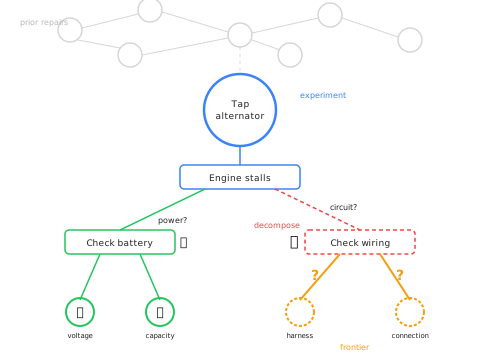
The graph says what to do next: swap in a known-good wire and test the circuit. That’s the perturbation. You can only decompose as far as you can isolate. For automobile electronics, signals are linear in an acyclic system — three bins suffice (converge, diverge, oscillate) and chaos can’t occur. But what about a nonlinear system with feedback?
A web server under load
A web application under load is nonlinear with feedback loops everywhere. Perturb it and all four bins show up:
- Convergence: add a server to the pool. Traffic redistributes, CPU drops, response times settle back to baseline.
- Divergence: a database replica falls behind. Queries reroute to the primary, which saturates. Connection pools exhaust, health checks fail, more nodes get pulled. Cascade until outage.
- Oscillation: the autoscaler adds pods when CPU spikes, removes them when it drops, overshoots both ways. The system cycles with a period set by the cooldown timer. SREs call it thrashing.
- Chaos: a retry storm across dozens of microservices with jittered backoff, combined with a cache stampede on expiry. A single GC pause in one service cascades unpredictably through the dependency chain. The response-time trace is aperiodic.
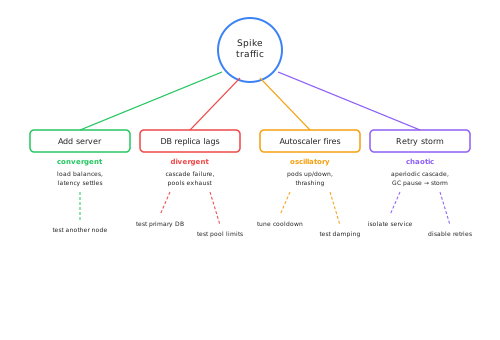
Same graph structure, all four bins occupied. The mechanic’s three-bin graph was the easy case. This is the general one.
The algorithm already running
The structure is the same everywhere:
- Pick a frontier node. (Choose what to test next.)
- Perturb the system. (Run the experiment.)
- Classify the response. (Read the shape.)
- Generate edges. (The shape names the open questions.)
- Repeat until the frontier stops expanding.
This is common sense. Doctors call it diagnosis. Engineers call it debugging. Toddlers call it playing.
I went looking for the mechanism in the sensemaking literature. Weick calls the loop enactment; Klein, recognition-primed decision; Boyd, OODA. They describe the loop in prose but never name the mechanism: how does the shape of a result generate the next question?
Shape is classifiable
A p-value is a scalar; the shape is gone. An e-value trajectory is a time series, and time series have shapes. Every trajectory does one of four things (Milnor, 1985; Strogatz, 2014):
| Settling | Non-settling | |
|---|---|---|
| Bounded | Convergence | Oscillation (periodic) / Chaos (aperiodic) |
| Unbounded | — | Divergence |
Four bins of triage, no gaps, no overlaps. Because the partition is exhaustive, each test eliminates at least one bin. Four bins, at most four tests to classify. Every elimination narrows what’s left and points to the most informative next experiment. The shape is the edge-generation mechanism; it just requires keeping the temporal structure that p-values throw away.
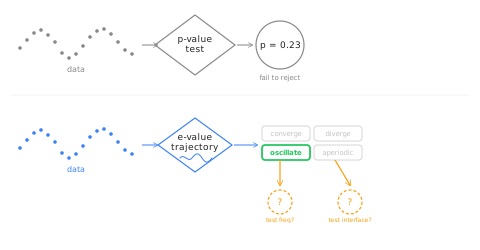
The previous post described four bins for this classification: converge, diverge, oscillate, chaos. The question was whether the classification works on composed e-value trajectories from heterogeneous experiments.
Kill conditions generate edges
I built a classifier that assigns these bins using a kill-condition decision tree:
- Test for monotone trend. If it fails → skip to periodicity.
- If monotone, test curvature. Decelerating → convergent. Constant → divergent.
- Test for spectral peaks. Narrow peak → oscillatory.
- Test for aperiodic structure → aperiodic.
- Nothing triggered → null.
Here’s what I noticed: each test that fires produces a label, but each test that misfires produces a hypothesis — an edge pointing to an experiment that would resolve it.
“Monotone trend detected, curvature indeterminate” → Is this system decelerating or drifting? Run a longer experiment.
“Spectral peak detected but broad” → Is this a noisy cycle or colored noise? Test at a different frequency.
“Nothing triggered” → Null, or wrong perturbation site? Test a different node.
The failure mode names the next hypothesis — that’s the edge-generation mechanism. Same structure as The Proof Manual: when induction fails because the residual loses structure, the failure mode names the escalation. A trend test can’t distinguish acceleration from deceleration? Check curvature. Kill conditions are the universal edge-generation rule. Doctors learn them by apprenticeship; mathematicians, by getting stuck. Nobody has written it down.
| Classification | What it tells you | What to try next |
|---|---|---|
| Convergent | Something absorbed the perturbation | Test a different node |
| Divergent | This is load-bearing, no backup | Test what depends on it |
| Oscillatory | Two subsystems fighting | Test the interface |
| Aperiodic | Input exceeds architecture capacity | Decompose differently |
Why e-values
Each node uses a different instrument, measures a different quantity, tests a different hypothesis. You can’t add fish counts to temperature readings, and you can’t combine p-values from adaptive experiments without inflating error.
E-values compose: their product remains valid even when each experiment was chosen based on the last (Grünwald et al., 2024). The composed trajectory carries the system’s dynamics, weighting each stream by its informativeness. Good diagnosticians already do this; the math confirms it.
The experiment tested this. Five sensor streams (normal, Poisson, exponential, Bernoulli, lognormal) sharing a weak forcing signal, each individually undetectable. Composed e-values classified the forcing pattern at F1 = 0.996 across four bins (convergent, divergent, oscillatory, aperiodic). Standardized sums: 0.478; individual streams: 0.279. Composition reveals shared forcing that individual streams miss because the likelihood ratio weights each stream by its informativeness — Fisher information weighting gives informative experiments more say.
Null results aren’t empty
In the p-value framework, a null result is a dead end: you failed to reject, so you move on.
But the e-value trajectory of that null has a shape. The trajectory didn’t grow, but how it didn’t grow is diagnostic:
- Oscillating null: the effect waxes and wanes. You tested at the wrong timescale. Edge: test at a different frequency.
- Converging null: there was an early signal that decayed. The system compensated. Edge: test the compensating mechanism.
- Trending-then-reversed null: the effect is real but transient. Edge: test the reversal point.
- Flat null: genuinely nothing. Dead end.
Only the flat null is a dead end. The other three are edges, lost in the compression to “fail to reject.”
Failed replications aren’t empty
A “failed replication” in the p-value framework is a single bit: the original said yes, the replication said no. Was the original wrong? Was the replication underpowered? Did the system change? The boolean can’t say.
The e-value trajectories of both experiments constrain the answer. If the replication oscillates where the original was monotone, something introduced feedback; if it converges where the original diverged, something is now compensating. Matching shapes with lower amplitude mean the effect is real but weaker.
How they disagree constrains why they disagree, and that constraint is the next hypothesis. Trajectories carry evidence about the mechanism of disagreement; booleans don’t.
Fixed point
The graph converges when every frontier edge points to a node already tested and stably classified — no new questions. Mathematicians call this a fixed point (where f(x) = x, the map returns what you gave it); computer scientists call it a fixpoint (where a computation stabilizes and halts). Same idea from two angles: the system has nothing left to say.
If every reachable node is visited, classifications are consistent, and composed e-values preserve the regime’s signature, the sequence converges to the true map — anytime validity lets you check at every node without inflating error.
I don’t have a theorem — I’m just showing you that good diagnosticians converge. The pieces exist: Chernoff proved adaptive experiment selection converges, He & Geng proved adaptive interventions recover causal structure, Grünwald proved e-values compose across adaptive experiments. No published theorem connects them. One would formalize what practitioners already do.
An observation
Suppose no algorithm for generating follow-up hypotheses exists. Hypotheses would be random, their order arbitrary. But the knowledge graph of science does expand, and our attention drives connections from one experiment to another. So the class of such algorithms must exist.
Popper was right that there’s no logical method of having new ideas from nothing. They come from the shape of the last experiment. The failure mode of the current test points to the next hypothesis. Kill conditions are one algorithm in this class. The class itself has no name and no formal study. Science on trial described the protocol that protects this loop: prereg, red-team, work log, publish all.
For any system you can perturb, the hypothesis graph decomposes it. Each perturbation produces a node, whose classification generates edges that point to the next perturbations. The graph expands until it covers the system’s structure, or until there’s a boundary you can’t perturb past.
The classification is limited to where you have:
- perturbation access (can’t poke what you can’t reach)
- independence between streams (correlated sensors weaken composition)
- identifiability (some systems look the same under all perturbations)
Within those limits, the algorithm converges. Outside them, it tells you where you’re stuck and why, which is itself an edge. Hume proved that causation can’t be deduced from observation alone. Sciences that can’t perturb their subject (astronomy, macroeconomics, paleontology) are structurally unable to learn causality this way. The hypothesis graph only works where you can poke.
Engineered systems are the best case. You have perturbation access and partial design knowledge. Every unexpected state is a free perturbation, every test failure is a node, and every failure mode is an edge. The hypothesis graph is how engineered complexity becomes legible: one perturbation at a time, with the kill condition telling you where to cut next.
If the thought process can be encoded, it can be scaled and repeated. The hypothesis graph encodes it: perturb, classify the shape, follow the edge. An agent that runs this loop doesn’t need intuition; it needs perturbation access and a classifier.
Open questions
- Algorithms that generate hypotheses from experimental shape exist across fields: model-based diagnosis (Reiter, 1987), algorithmic debugging (Shapiro, 1983), counterexample-guided synthesis (Clarke et al., 2003), abduction (Peirce). Each formalizes a slice. No cross-domain theory characterizes what they share: a mismatch between predicted and observed structure, converted into constraints that select the next hypothesis or experiment.
- Can the hypothesis graph be shown to converge to the true causal structure under stated conditions? The pieces exist independently (Chernoff, He & Geng, Grünwald). Connecting them is open.
- What happens at the boundary where perturbation access runs out? The graph tells you where you’re stuck, but is that boundary information formally recoverable, or just a practitioner’s intuition?
- Some systems violate every assumption (no isolation, correlated streams, unidentifiable structure) and people still learn them. Parenting Horizons explores the case where the measurement window is shortest relative to the system’s dynamics, and two rational observers have no shared formalism to resolve their disagreement.
If we can poke it, we know how to know.