The Power Diagram Auction: A Formally Verified VCG Mechanism for LLM Advertising
Download PDF · arxiv-shape preprint, rebuilt from this source. · Archived at doi.org/10.5281/zenodo.21723924 (CC BY-SA 4.0).
Abstract
Large language model (LLM) assistants create an advertising surface where conversations express intent beyond keywords. We develop an auction that combines targeting preferences and willingness to pay in a single report. Each conversation embeds as a point x in a continuous space of hundreds of dimensions, and each advertiser declares a center c (their customer). The conceptual distance between them measures how closely they match. A reach σ (how widely they serve) and a bid b (what a conversion is worth) compare that distance against a willingness to pay. The slot beside the reply goes to the advertiser with the highest log(b) - ‖x-c‖²/σ². The mechanism involves no model training or response modification. We prove in Lean 4, with zero sorry, that the rule’s argmax allocation with Clarke payments forms a VCG mechanism. Truthful reporting is weakly dominant, the allocation maximizes welfare at every query point, and its territories form a power diagram with keyword auctions as the degenerate case. This mechanism allows an auction to sell regions of embedding space.
1. One-Shot Bidding
Keyword auctions are strategically broken, and the industry monetizes the breakage. Edelman, Ostrovsky and Schwarz (2007) proved that Google’s Generalized Second-Price auction has no dominant-strategy equilibrium, so your optimal bid depends on bids you cannot see. First-price display auctions require shading by an amount that also depends on bids you cannot see. An autobidding industry answered, agents running machine learning against each other to approximate what Vickrey (1961) made exact sixty-five years ago in one shot: report your value, pay the externality, done.
Ad auctions for large language models (LLMs) restart the design problem. A user’s conversation embeds to a point x in a real inner product space, in practice a few hundred dimensions. Each advertiser declares a center c (who their customer is), a reach σ (how wide a neighborhood they serve), and a bid b (what a conversion is worth). The platform scores each advertiser at x and the highest score wins. The scoring rule predates this paper.1 An open-source exchange implements it, multi-agent simulations probe its market dynamics, and an interactive explorer renders the allocation live. The mechanism lacked a proof that it deserves the trust the proposal asks for.
We connect a geometric bidding language to VCG and verify that connection in Lean. The formalization covers truthful reporting of center, reach, and bid. It identifies the allocation as a power diagram, using a lift when reaches differ, and recovers the single-item Vickrey auction at a shared center. These guarantees can be checked by running a build command. The bridge lemma, score_eq_log_reportedVal, shows that the scoring rule is the logarithm of the value a report implies, without assuming truthful reporting. This identity connects the allocation to the classical incentive argument of Vickrey (1961), Clarke (1971), and Groves (1973).
2. Model
An advertiser’s report is a triple (c, σ, b):
| Field | Name | The advertiser declares |
|---|---|---|
c ∈ E | center | who their customer is, a point in embedding space |
σ > 0 | reach | how wide a neighborhood around c they serve |
b > 0 | bid | what a conversion is worth to them |
Their private valuation is a triple (c*, σ*, v) of the same shape, and each report field may differ from its starred counterpart. The distinction is operational. Reported distance controls which impression the advertiser wins; true distance controls whether the person who sees the ad converts. A supplement advertiser can declare its center on running-shoe queries, but the declaration does not turn supplements into shoes. Its true value at query x remains Gaussian around its private center:
trueVal(x) = v · exp(-‖x - c*‖² / σ*²)True value reads as margin times conversion rate: v is the margin a conversion clears, and the Gaussian factor is the probability that the lead at x converts. σ is a length scale: the Gaussian is unnormalized, and the exponent carries no ½. The Gaussian is strictly positive: even a badly matched impression can convert, only with a probability that decays rapidly with semantic distance. That is the object observed in impression advertising, not a binary relevance label.
Advertisers express their positioning in natural language and refine it by inspecting example queries, as described in Buying Space, Not Keywords and Marketing-Speak Is the Protocol. The mechanism represents that positioning with a center, a scalar reach, and a bid. We leave controls for specifying more detailed preference geometry outside the scope of this work. Separately, we assume true valuations belong to the isotropic Gaussian family; the theorems hold within that model. The platform scores reports by
score(x) = log(b) - ‖x - c‖² / σ²and allocates each query to an argmax of score. Thus allocation uses the reported Gaussian while utility uses the fixed true Gaussian. Changing a report changes the impressions won, never the underlying conversion surface. The winner pays the Clarke pivot. With a single winner per query, the pivot has a closed form: losers pay nothing, and the winner pays the runner-up’s implied value (zero when unopposed).
payment_w(x) = max_{j ≠ w} b_j · exp(-‖x - c_j‖² / σ_j²)Utility is quasilinear. Impressions are opt-in opportunities. The model does not force an advertiser into an auction it declined to enter. A publisher may separately restrict eligibility, but that policy defines the player set upstream and is not a second allocation mechanism in the model. All definitions follow Nisan’s mechanism-design chapter in Nisan, Roughgarden, Tardos and Vazirani, eds. (2007).
The scoring rule is the embedding-space member of a known family. Lahaie and Pennock (2007) analyzed keyword scoring rules of the form bid × quality^s. With the score’s logarithm taken in base β, ranking by score is ranking by b · q^ln(β) with quality q = exp(-‖x-c‖²/σ²). The log base is therefore the squashing parameter, s = ln(β), and the squashing-parameter literature transfers intact. Sweeping the log base is the platform’s revenue-relevance dial.
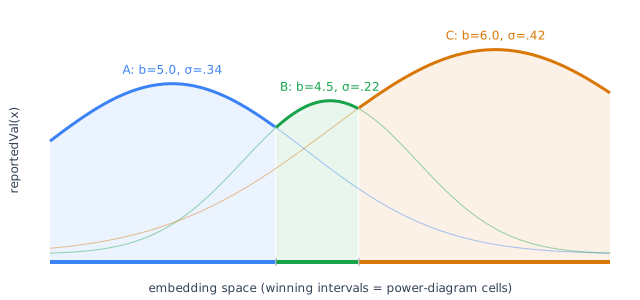
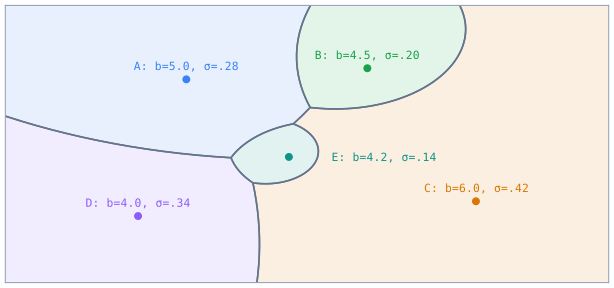
The formalization states everything over an arbitrary real inner product space. No finite-dimension hypothesis appears anywhere in the chain. The theorems hold for a 384-dimensional sentence embedding and for next year’s wider one alike. Drawn in one and two dimensions, the figures show the structure that survives the trip up: cells, boundaries, argmax. Their proportions do not survive it. In three hundred dimensions distances concentrate and most of a cell’s volume sits near its boundary. Pictures illustrate; theorems generalize.
3. The Bridge
The mechanism-design results hang on one identity. Define the value implied by a report, reportedVal(x) = b · exp(-‖x - c‖²/σ²). Then
score(x) = log(reportedVal(x))
with no truthfulness hypothesis (score_eq_log_reportedVal). The disguise is a logarithm. Log is monotone, so the argmax of score is the argmax of reported value. The mechanism always maximizes reported welfare, which is the allocation rule VCG requires. When a report is truthful, reported value equals true value (reportedVal_eq_trueVal_of_truthful), and the same identity becomes score = log(trueVal) (score_eq_log_trueVal). The winner is the advertiser who values the impression most (winner_maximizes_welfare).
4. Weakly Dominant Strategy
4.1 The Incentive Theorem
Theorem (Dominant-strategy incentive compatibility, vcg_dsic). Fix a query and the reports of all other advertisers. Under the stated allocation and payment rules, an advertiser whose true valuation belongs to the Gaussian family obtains at least as much quasilinear utility by reporting its true center, reach, and value as by submitting any alternative valid report.
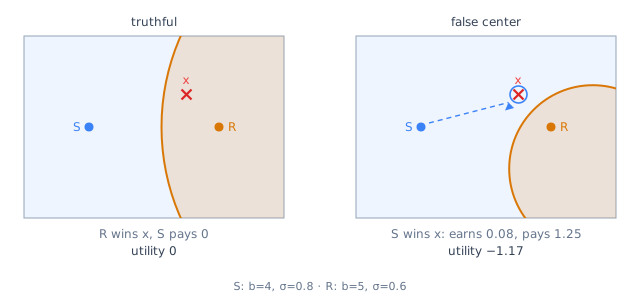
The Clarke payment depends only on others’ reported values, so a player’s report moves their allocation and never their price schedule (welfareOthersWithout_invariant); the four-case comparison then closes the argument. A false center can make the supplement advertiser win the running-shoe impression, but its utility still contains the small true supplement-conversion value, while its payment equals the value of the shoe advertiser it displaced. In the figure’s instance, the supplement advertiser S’s books at the shoe query x:
S’s ledger at x | truthful | false center |
|---|---|---|
| allocation | loses x | wins x |
earns (true value at x) | 0 | 0.08 |
| pays (Clarke pivot) | 0 | 1.25 |
| utility | 0 | −1.17 |
With one rival the pivot is the rival’s reported value, so a winner’s utility is its maximum willingness to pay at x less what the competitor’s report says the impression is worth. The accounting generalizes: the same four rows settle any deviation, in any dimension, against any number of rivals, in one shot. vcg_dsic is this table quantified over all of them.
vcg_dsic proves more than the informal claim usually attached to VCG. The truthfulness it certifies constrains all three report fields: center, reach, and bid. Misreporting your center toward a traffic hotspot is a deviation r' like any other, and the theorem says it cannot profit you.
4.2 Observational Equivalence
Weak dominance does not by itself identify the literal report. In a thin market, an unopposed winner pays zero, and every center report that preserves its allocation gives the same utility. The artifact proves the limiting case explicitly, with pointwise and expected utility invariant under every report when only one player competes (playerUtility_invariant_of_subsingleton, expectedPlayerUtility_invariant_of_subsingleton).
Competition closes that gap. A center deviation that crosses a contested allocation boundary sacrifices true surplus and is strictly worse (vcg_strict_at_contested_point), and when the disagreement covers a positive-weight region the loss survives aggregation (vcg_strict_expected_on_allocation_change_set). Observational equivalence remains: reports that preserve allocation where competition matters. An expected-utility tie cannot place positive query weight on queries where the allocations disagree and the deviation is strictly worse (expected_utility_tie_disagreement_not_positive). Finite weighted query logs construct the required strictness witness whenever that set contains a logged query of positive weight.
4.3 Spatial Competition
The strictness theorems answer the most immediate Hotelling objection. In spatial competition from Hotelling (1929) onward, sellers drift toward the center of the market, and the analogue in embedding space is advertisers declaring centers near high-traffic regions. VCG makes truthful center reporting weakly dominant, so Hotelling drift cannot increase advertiser utility. Competition converts false spatial proximity from a costless declaration into a strictly costly allocation error. A reported center changes placement but not customer fit: the supplement advertiser from that ledger still earns its small true value while paying for the shoe advertiser it displaces. As rival coverage thickens, the allocation-equivalent class can contract toward the advertiser’s true center. Under the artifact’s explicit spatial-coverage condition, every selection from that surviving class converges to c* (centers_converge_of_competitive_coverage). The convergence result is conditional rather than a claim about adjustment dynamics, and profitable drift can return through what the model excludes: budgets, volume-dependent objectives, endogenous products or creatives, and non-Gaussian true values.
4.4 Comparison with Alternative Mechanisms
The qualifier earns its value in comparison. GSP gives keyword bidders no dominant strategy (Edelman, Ostrovsky and Schwarz, 2007), and even an exact second-price keyword auction makes only the bid truthful: keyword selection and match types remain strategic choices made against unobserved rivals, so targeting sits outside the incentive guarantee. In the present mechanism targeting is part of the report, and the guarantee covers it. The same comparison orders the LLM mechanisms:
| Mechanism | Truthful report | Allocation | Welfare | Proof |
|---|---|---|---|---|
| GSP (keywords) | none exists | deterministic | unguaranteed | — |
| Vickrey (keywords) | bid only; targeting strategic | deterministic | per conflated bin | classical |
| MOSAIC | reward function | randomized softmax | approximate | paper |
| Retrieval-time | bid only | probabilistic draw | unguaranteed | paper |
| LLM-Auction (training) | no report to state | weights, opaque | unstated | none |
| Power diagram | bid, center, reach | deterministic argmax | exact, pointwise | Lean, zero sorry |
Italics mark the concessions.
5. Geometry
The name “power diagram auction” is now a theorem: in E when advertisers share a reach, and in E × ℝ when they do not.
5.1 Equal Reach
When two advertisers share σ, comparing scores at x is comparing power distances ‖x - c‖² - w with sites at the centers and weights w = σ² log(b) (score_le_iff_powerDist_le). The score difference is an affine function of x (score_sub_affine), so cell boundaries are hyperplanes. That is the classical power diagram of Aurenhammer (1987), with bids setting the weights. When every advertiser shares σ, the winner rule is that cell assignment in E directly: the argmax of score minimizes power distance (winner_minimizes_powerDist). No lift required.
5.2 Heterogeneous Reach
With distinct σs the in-space boundaries curve, and the folk description of the allocation as a power diagram fails in E. It succeeds in E × ℝ. Lift each query to the paraboloid (x, ‖x‖²). Each report (c, σ, b) determines a lifted site and weight under which maximizing score is minimizing lifted power distance. The auction’s winner rule is then the lifted diagram’s cell assignment (liftedPowerDist_paraboloid, score_le_iff_liftedPowerDist_ge, winner_minimizes_liftedPowerDist; the site and weight formulas are in PowerDiagram.lean). Aurenhammer proved diagrams of quadratic distance functions lift this way; the formalization instantiates his lift for this scoring rule and checks the algebra once. The explorer renders the cells live.
The lift also helps at serving time. Score comparisons are affine in the lifted query (x, ‖x‖²), reducing winner selection to maximum-inner-product search over static advertiser vectors. Approximate indexes can retrieve candidates, but exact VCG clearing requires certifying the winner and runner-up. A full O(N) scan provides the exact fallback; the O(log N) point-location bounds available in fixed low dimensions do not extend to embedding dimension.
6. Keywords Recovered
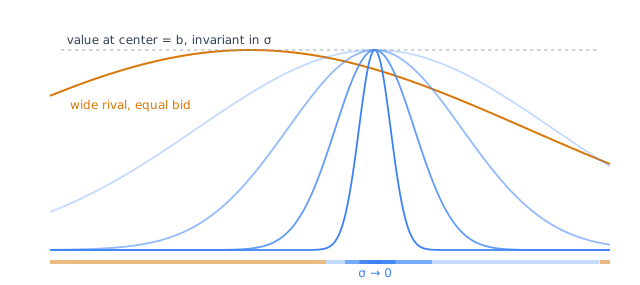
The mechanism contains the single-item Vickrey auction as a special case. Two results connect it to point-based keyword bidding: a report concentrates at its center as reach shrinks, and allocation and payment reduce exactly to Vickrey’s rule when the query is every advertiser’s shared center.
6.1 The σ → 0 Limit
At any point other than its center, a report’s score diverges to -∞ as σ → 0, while its score at the center is log(b) independent of σ (keyword_is_degenerate_limit, score_at_center). The tiny circle collapses to its point.
6.2 Exact Vickrey
At a query point that is every advertiser’s shared center, the Gaussian factor is exp(0) = 1 for every bidder, so reported value is the bid. The winner is a highest bidder (winner_maximizes_bid_of_common_center), the Clarke pivot equals the highest competing bid (vcgPayment_common_center_second_price), and every loser pays nothing (vcgPayment_eq_zero_of_loser). At a shared center, the embedding auction is Vickrey’s sealed-bid second-price auction, allocation and payment both.
7. Optimality
Pointwise welfare maximization integrates. For any measure over queries, expected welfare under the score-argmax allocation weakly dominates expected welfare under any rule the expectation operator evaluates, power-diagram or not (integral_efficiency, gaussian_optimality; the theorem statements carry the exact quantifiers). gaussian_vcg_weakly_dominates brings welfare optimality and dominant-strategy incentive compatibility together with efficiency at truthful equilibrium. The equilibrium result follows by evaluating the welfare guarantee at truthful play, which vcg_strategyproof certifies as a Nash equilibrium. Truthful reporting maximizes each advertiser’s utility against fixed rival reports (vcg_dsic). When all advertisers report truthfully, the allocation maximizes total advertiser value.
The artifact separately proves the equilibrium-decomposition theorem of Ghani, Hedges, Winschel and Zahn (2018). In their open games, where large games compose from smaller ones, an equilibrium of the composite induces equilibria of the components (composed_equilibria_decompose). Whether DSIC composes the same way remains open, and the formalization records it as open instead of assuming it.
Welfare, as the Model defines it, means willingness to pay. A true value b · exp(-‖x-c*‖²/σ*²) is what a conversion at query x is worth to the advertiser, so pointwise welfare maximization routes every query to the bidder willing to pay the most there, and the incentive theorems keep the declared curves honest about where that willingness lives. The guarantee is also dimension-free, and the keyword language is not. A keyword is a point report whose territory vanishes in high dimension, so covering an embedding space with keywords takes exponentially many reports, while a Gaussian describes a region with one center, one reach, and one bid.
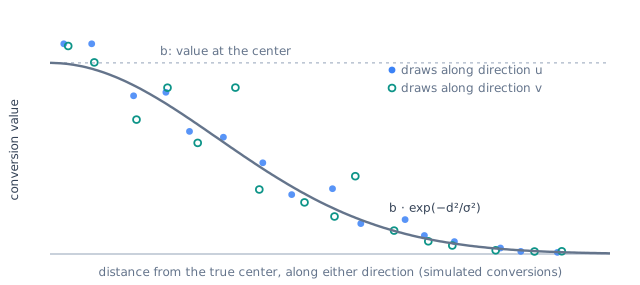
The weak-order chain uses one modeling assumption, QueryMeasure.integral_mono: a monotone expectation operator respects pointwise inequality (no normalization or probability mass required). Strict expected comparisons additionally carry PositiveAt or PositiveOn, stating that the operator detects a contested point or region. These are structural hypotheses, not Lean axioms. QueryMeasure.dirac and QueryMeasure.ofWeightedFinset construct the operator. A finite weighted query log constructs the strictness witness whenever a contested region contains a logged query of positive weight. A measure-theoretic integral satisfies the corresponding interfaces on functions and positive-mass regions it can evaluate. Keeping the operator abstract lets the theorems quantify over query distributions instead of fixing one, and each theorem carries the exact strength it uses.
8. Related Work
8.1 LLM Ad Auctions
Feizi, Hajiaghayi, Rezaei and Shin (2025) survey the design space as four modules (modification, bidding, prediction, auction) and leave open how the pieces sustain an ad ecosystem. The idea of an auction inside the generation begins with Dütting, Mirrokni, Paes Leme, Xu and Zuo (2024), who aggregate advertisers’ token distributions into the reply and price the result through a monotonicity condition. Dubey, Feng, Kidambi, Mehta and Wang (2024) auction placements inside an LLM-written summary of the ads. MOSAIC and the retrieval-time mechanism are later points on that line; all of them keep the ad inside the text the model emits.
Soumalias, Curry and Seuken (2025) give the prior LLM ad mechanism with dominant-strategy guarantees. Their MOSAIC auction allocates the reply itself: advertiser reward functions score candidate responses sampled from the model, and softmax selects one. Computing the exact welfare-maximizing reply is out of reach, so exact VCG is unavailable. The softmax allocation is instead cyclically monotone, and Rochet (1987) turns cyclic monotonicity into dominant-strategy payments through a convex potential. Auctioning an embedded intent point instead of the reply shrinks the outcome space from token sequences to a finite set of known advertisers. Exact VCG becomes one argmax plus one counterfactual argmax, and the guarantees become simple enough for Lean to check. Allocating a separate ad object also removes MOSAIC’s deployment costs: no multi-candidate generation per query, deterministic winners an advertiser can budget against, and a discrete placement that can be attributed and priced.
Hajiaghayi, Lahaie, Rezaei and Shin (2024) place the auction at retrieval time instead: their mechanism retrieves ads probabilistically per discourse segment, by bid and relevance, with incentive-compatible pricing. The outcome space is far smaller than MOSAIC’s, but the placement still lives inside the generated text, and the winner is a draw rather than an argmax. The geometric mechanism keeps the retrieval-time simplicity while making the allocation deterministic and the ad a separate object.
Alaei, Makhdoumi and Malekian (2026) share the geometric premise: a user is an unknown preference vector, each advertiser a feature vector, match value their inner product. Their platform learns the vector as the conversation proceeds, trading a sharper estimate against the risk the user leaves. The static Model holds that learning dynamic fixed, and fixing the query point and the Gaussian family buys the closed-form diagram and the compiled proof.
The other family bakes advertising into the model by training. Alibaba’s LLM-Auction post-trains the model with preference alignment to balance ad revenue against user experience, encoding commercial incentives directly in the weights. Training is the wrong cadence for an ad market: campaigns change hourly, fine-tuning takes weeks, and retraining per campaign rotation costs more than the campaign.
It is also the wrong trust surface. Outsiders cannot audit bias learned in weights, and users cannot police it from inside either: evaluators shown chatbot responses with embedded ads failed to detect the ads and preferred the responses that contained them. The power-diagram mechanism is the opposite limiting case. The public scoring rule determines the allocation, and the formal incentive guarantee is independently checkable.
8.2 Semantic Matching
Advertisers competing in a vector space is not new. Grbovic et al. (2016) learned joint query and ad embeddings to match ads beyond literal keywords, and embedding-based retrieval is now standard ad-system infrastructure. In that line the geometry supplies candidates or relevance features to a separate auction. In the power diagram the distance function is the valuation, and the auction is the geometry.
8.3 Formalized Auctions
Caminati, Kerber, Lange and Rowat (2013) proved soundness of combinatorial Vickrey auctions in Isabelle and generated verified executable code. Barthe, Gaboardi, Gallego Arias, Hsu, Roth and Strub (2015) verified incentive compatibility for VCG in a probabilistic relational calculus, and Jouvelot and Gallego Arias (2022) built mech.v, a Coq library that proves VCG’s incentive properties generically and refines an online-advertising VCG down to that specification. Formalized VCG is not new, and neither is a verified online-ad mechanism. What this artifact adds is the object: the verified allocation is a partition of a vector space, and the same artifact that checks truthfulness checks its identification as a power diagram. Kerber, Lange and Rowat (2016) formalized Vickrey’s auction in Isabelle and argued mechanized reasoning should be ordinary practice in economic theory; Ghani, Hedges, Winschel and Zahn (2018) rebuilt game theory compositionally so that mechanisms assemble from smaller games. The artifact extends the practice from a discrete allocation rule to a geometric one.
8.4 Filters and Reserves
Hartline, Hoy and Taggart (2023) show competitive efficiency survives reserve pricing. The same holds trivially for any pre-auction relevance filter, since welfare maximization restricted to a nonempty eligible set is welfare maximization on that set (tau_preserves_efficiency_among_eligible). Revenue also lives in reserves. The Clarke pivot collects only the runner-up’s implied value, zero when a winner is unopposed, and a reserve puts a price floor under exactly those impressions.
9. Limits
| Element | In the formalization |
|---|---|
Embedding space E | any real inner product space; dimension unconstrained |
| Advertisers | arbitrary finite type; no bound on the count |
| Query distribution | universally quantified expectation operator; one assumption, monotonicity |
| Utility | quasilinear; no budget constraints |
| True valuations | isotropic Gaussian family |
| Deviations | any (center, σ, bid) triple |
| Rival allocation rules | any rule the expectation operator evaluates |
| Winners per query | exactly one; ties broken by fixed enumeration |
Single winner. Slates, pacing, and cross-impression externalities are outside the model.
No budgets. Budget-constrained clearing has known structure (with fixed impression quotas it is semi-discrete optimal transport, whose solution is again a power diagram; monetary budgets are harder, since spend depends on runner-up values, not cell mass), but its incentives and dynamics are open. The simulations suggest the dynamics are where the difficulty lives.
Gaussian truth. The isotropic Gaussian family gives the auction a compact bidding language and tractable geometry. Choosing that language trades expressiveness against clearing cost, as in combinatorial auctions (Nisan, 2000). The incentive theorem assumes true valuations can be expressed in this language. Anisotropic Gaussian preferences retain the logarithmic bridge, but extending the formalization and geometric representation lies beyond this paper.
Frozen embedder. We hold the embedding model fixed. Retraining or replacing it moves every conversation point and every declared center at once, invalidating reports with no advertiser misreporting anything; re-declaration cadence is an operational question the model does not pose.
Statics only. Nothing in the artifact says bidding dynamics converge. The simulations study the dynamics empirically; a formal convergence or limit-cycle result would be a separate paper’s contribution.
10. Discussion
Why now? Four implications answer, outside the theorems but shaped by them. Each names its evidence.
The minimum viable firm shrinks. Coase (1937) set the boundary of the firm where the cost of transacting outside it exceeds the cost of organizing inside, so the boundary moves when transaction costs do. A recent literature asks whether AI agents collapse those costs market-wide; Shahidi, Rusak, Manning, Fradkin and Horton (2025) call the limit the Coasean singularity. But the collapse runs through discovery, because small firms survive by specialization, and specialization only pays where specialists can be found. The market on offer prices discovery for scale, because keyword advertising amortizes vocabulary research, bidding infrastructure, and autobidding retainers only over large budgets, and training-based placement gates entry on the platform’s fine-tuning calendar. The market specialists need prices a campaign at one report, allocates efficiently, admits any campaign size, and can discover a more diverse population of firms.
So positioning becomes the bidding language. The power-diagram mechanism replaces the keyword portfolio with one report per campaign. The report says who the customer is, how far the claim extends, and what the fit is worth. This is the market position statement made formal, and every marketer already writes one, because the position statement is the first document a campaign produces. Advertisers think in positioning and users think in problems, so keywords became the middle vocabulary both sides had to learn, the compression lost the situation that makes a customer the right fit, and the platform that authored the vocabulary charged rent for the translation. This report drops the keyword translation while retaining a familiar auction at a shared center: Keywords Recovered proves that allocation and payment there reduce exactly to Vickrey’s rule. The declaration also binds, because the incentive theorem covers all three fields, so no misdeclaration profits and the allocation-changing ones cost. Richer bidding languages have paid before; Sandholm (2007) cleared $35 billion of sourcing through expressive combinatorial bids and reported $4.4 billion of hard-dollar savings. But that evidence comes from procurement, so advertising is the untested extension, and a deployment would measure whether the one-report campaign lowers the minimum profitable campaign size and shifts entry toward smaller firms.
The keyword tax shrinks with it. Levin and Milgrom (2010) call the tax conflation, pooling heterogeneous items into one auction. A keyword bin is conflation at the item-definition layer, where the climbing specialist pays to compete on pelvic-floor queries it will never convert. But heterogeneous reach un-conflates, because a tight specialist wins where its reported value leads without submitting a separate bid for every nearby keyword. The geometry section proves the carving, and the simulations estimate the surplus it recovers in a synthetic fifteen-advertiser market. But those estimates have to clear Levin and Milgrom’s own counterweight, since finer segmentation can thin markets and weaken price discovery. The ecological hypothesis pushes back, because a finite keyword vocabulary routes demand only to businesses it has words for, while a continuous positioning space can host any firm a center and a reach can describe, so the richer language admits a more diverse population of discoverable firms. And the pattern has retail precedent, because when online catalogs lowered discovery costs, Brynjolfsson, Hu and Smith (2006) measured demand shifting into the niche tail.
But the collapse runs on elicited information. Cheap coordination does not supply the information coordination needs, because dispersed knowledge must be elicited (Hayek (1945)), and advertising is the market that produces the who-serves-whom half of it; Nelson (1974) founded the economics of advertising on its information content. The stakes run to the whole margin, because the Model prices true value as margin times conversion rate, so the ceiling on what an advertiser will pay for discovery is everything the sale clears, and the mechanism sets which share changes hands. So the incentives of the mechanism that clears it set the quality of that information. Conflated auctions produce conflated knowledge, weights produce knowledge nobody can audit, and in the power diagram, truthful reporting is the compiled incentive. The agent economy therefore inherits the incentives of whatever clears its discovery.
The open problems:
- whether DSIC composes across open games (recorded open in the artifact, with the equilibrium half proved)
- whether bidding dynamics converge once budgets enter the mechanism
The open measurements:
- what it costs an advertiser to estimate a report
- whether the richer bidding language cuts campaign setup cost and misallocation
- whether specialist surplus, market thickness, and small-firm entry hold up together
- whether allocations stay stable after embedder recalibration
Artifacts
Formalization
The formalization is at github.com/kimjune01/auction-proof, archived as DOI 10.5281/zenodo.21214697, AGPL-3.0, Lean 4 (v4.29.0-rc6) with Mathlib. Verification:
lake exe cache get
lake build
Zero sorry, and no trusted axiom of our own. #print axioms on every theorem below returns only Lean’s three standard background axioms (propext, Classical.choice, Quot.sound), because the single modeling assumption is a QueryMeasure typeclass that concrete instances discharge by proof. The claims-to-theorems map:
| Claim | Lean theorem | File |
|---|---|---|
| score = log(reported value) | score_eq_log_reportedVal | Efficiency.lean |
| winner maximizes true welfare | winner_maximizes_welfare | Efficiency.lean |
| truthful reporting is dominant | vcg_dsic | Strategyproof.lean |
| no allocation rule beats VCG | gaussian_optimality | GaussianOptimality.lean |
| capstone conjunction | gaussian_vcg_weakly_dominates | GaussianOptimality.lean |
| equal-σ power diagram, hyperplane bisectors, winner minimizes power distance | score_le_iff_powerDist_le, score_sub_affine, winner_minimizes_powerDist | PowerDiagram.lean |
| variable-σ power diagram via paraboloid lift | liftedPowerDist_paraboloid, winner_minimizes_liftedPowerDist | PowerDiagram.lean |
| keyword limit | keyword_is_degenerate_limit | VectorSpace.lean |
| exact Vickrey at a keyword point | vcgPayment_common_center_second_price | SecondPrice.lean |
| losers pay nothing | vcgPayment_eq_zero_of_loser | Strategyproof.lean |
Exchange
vectorspace-adserver implements the mechanism as an open-source exchange, live at vectorspace.exchange and archived as DOI 10.5281/zenodo.21365911: the scoring rule, the argmax allocation, and the Clarke pivot.
Simulations
openauction/cmd/simulate, archived as DOI 10.5281/zenodo.21366035, runs the market on real BGE-small-en-v1.5 embeddings: fifteen advertisers, 62 queries, 50 randomized trials, keyword and embedding clearing compared head to head. Keyword Tax and Relocation Fees report the results.
Explorer
vectorspace-ads renders the allocation live, archived as DOI 10.5281/zenodo.21365798: drag a center or raise a bid and the territories shift.
Acknowledgments
Conversations with Sébastien Lahaie and Mohammad Hajiaghayi sharpened the mechanism-design framing, and Sébastien pointed me to MOSAIC. Errors, and the claims, are mine.
Disclosures
LLM use. This paper and its artifact were produced with large language models via Claude Code. The author directed the research and reviewed every claim; agents wrote the Lean proofs, generated the figures, and drafted the prose. A separate model ran an adversarial review of the prose against the formalization. No guarantee in this paper rests on any model’s judgment: the artifact type-checks with zero sorry, and verification reduces to lake build.
Funding. Self-funded independent research. No external funding, no employer direction, no advertiser or platform relationship.
References
Alaei, S., Makhdoumi, A., and Malekian, A. (2026). Dynamic Learning and Optimal Advertising Mechanism for LLM Platforms. SSRN working paper.
Aurenhammer, F. (1987). Power Diagrams: Properties, Algorithms and Applications. SIAM Journal on Computing 16(1), 78–96.
Barthe, G., Gaboardi, M., Gallego Arias, E. J., Hsu, J., Roth, A., and Strub, P.-Y. (2015). Computer-Aided Verification in Mechanism Design. arXiv:1502.04052.
Brynjolfsson, E., Hu, Y. J., and Smith, M. D. (2006). From Niches to Riches: Anatomy of the Long Tail. Sloan Management Review 47(4), 67–71.
Caminati, M. B., Kerber, M., Lange, C., and Rowat, C. (2013). Proving Soundness of Combinatorial Vickrey Auctions and Generating Verified Executable Code. arXiv:1308.1779.
Caplan, P. C. (2021). Higher-Dimensional Power Diagrams for Semi-Discrete Optimal Transport. arXiv:2106.14730.
Clarke, E. H. (1971). Multipart Pricing of Public Goods. Public Choice 11, 17–33.
Coase, R. H. (1937). The Nature of the Firm. Economica 4(16), 386–405.
Dubey, K. A., Feng, Z., Kidambi, R., Mehta, A., and Wang, D. (2024). Auctions with LLM Summaries. arXiv:2404.08126.
Dütting, P., Mirrokni, V., Paes Leme, R., Xu, H., and Zuo, S. (2024). Mechanism Design for Large Language Models. arXiv:2310.10826.
Edelman, B., Ostrovsky, M., and Schwarz, M. (2007). Internet Advertising and the Generalized Second-Price Auction: Selling Billions of Dollars Worth of Keywords. American Economic Review 97(1), 242–259.
Feizi, S., Hajiaghayi, M., Rezaei, K., and Shin, S. (2025). Online Advertisements with LLMs: Opportunities and Challenges. arXiv:2311.07601.
Ghani, N., Hedges, J., Winschel, V., and Zahn, P. (2018). Compositional Game Theory. LICS ‘18; arXiv:1603.04641.
Grbovic, M., Djuric, N., Radosavljevic, V., Silvestri, F., Baeza-Yates, R., Feng, A., Ordentlich, E., Yang, L., and Owens, G. (2016). Scalable Semantic Matching of Queries to Ads in Sponsored Search Advertising. SIGIR ‘16; arXiv:1607.01869.
Groves, T. (1973). Incentives in Teams. Econometrica 41(4), 617–631.
Hajiaghayi, M., Lahaie, S., Rezaei, K., and Shin, S. (2024). Ad Auctions for LLMs via Retrieval Augmented Generation. arXiv:2406.09459.
Hartline, J., Hoy, D., and Taggart, S. (2023). Robust Analysis of Auction Equilibria. arXiv:2310.03702.
Hayek, F. A. (1945). The Use of Knowledge in Society. American Economic Review 35(4), 519–530.
Hotelling, H. (1929). Stability in Competition. The Economic Journal 39(153), 41–57.
Jouvelot, P., and Gallego Arias, E. J. (2022). mech.v: A Coq Formalization of Mechanism Design. GitHub repository.
Kerber, M., Lange, C., and Rowat, C. (2016). An Introduction to Mechanized Reasoning. Journal of Mathematical Economics 66, 26–39.
Lahaie, S., and Pennock, D. M. (2007). Revenue Analysis of a Family of Ranking Rules for Keyword Auctions. EC ‘07, 50–56.
Levin, J., and Milgrom, P. (2010). Online Advertising: Heterogeneity and Conflation in Market Design. American Economic Review 100(2), 603–607.
Nelson, P. (1974). Advertising as Information. Journal of Political Economy 82(4), 729–754.
Nisan, N. (2000). Bidding and Allocation in Combinatorial Auctions. EC ‘00.
Nisan, N., Roughgarden, T., Tardos, É., and Vazirani, V. V., eds. (2007). Algorithmic Game Theory. Cambridge University Press.
Rochet, J.-C. (1987). A Necessary and Sufficient Condition for Rationalizability in a Quasi-Linear Context. Journal of Mathematical Economics 16(2), 191–200.
Sandholm, T. (2007). Expressive Commerce and Its Application to Sourcing: How We Conducted $35 Billion of Generalized Combinatorial Auctions. AI Magazine 28(3).
Shahidi, P., Rusak, G., Manning, B. S., Fradkin, A., and Horton, J. J. (2025). The Coasean Singularity? Demand, Supply, and Market Design with AI Agents. In The Economics of Transformative AI. NBER.
Soumalias, E., Curry, M. J., and Seuken, S. (2025). Truthful Aggregation of LLMs with an Application to Online Advertising. arXiv:2405.05905.
Tang, B. J., Sun, K., Curran, N. T., Schaub, F., and Shin, K. G. (2024). Ads that Talk Back: Implications and Perceptions of Injecting Personalized Advertising into LLM Chatbots. arXiv:2409.15436.
Vickrey, W. (1961). Counterspeculation, Auctions, and Competitive Sealed Tenders. Journal of Finance 16(1), 8–37.
Zhao, C., Hu, Q., Song, S., Chen, D., Zhu, H., Xu, J., and Zheng, B. (2025). LLM-Auction: Generative Auction towards LLM-Native Advertising. arXiv:2512.10551.
Part of the Vector Space series.
Footnotes
-
Proposal series: june.kim/power-diagrams-ad-auctions, june.kim/the-price-of-relevance, june.kim/keywords-are-tiny-circles, june.kim/marketing-speak-is-the-protocol. Implementation: github.com/kimjune01/vectorspace-adserver. Simulations: june.kim/relocation-fees, june.kim/relocation-fee-dividend. Demo: june.kim/vectorspace-ads, archived as DOI 10.5281/zenodo.21365798. ↩