Facsimile Response
A spark starts a wildfire. We trace it to a campfire or power line, then assign fault and remove the ignition source. Yet the same spark fell yesterday and went out, which means the spark explains the timing but not the scale.
If preventing sparks prevents fires, why look further?
spark
  + dry fuel
  + accumulated brush
  + wind
  + terrain
  + combustible buildings
  + limited response capacity
  → disaster
Calling the spark the cause compresses this graph into its final visible event and gives us an obvious response. We ban campfires, harden power lines, and restrict machinery. As a result, some fires never start, and each success strengthens a rule that can travel without its causal model:
When fire follows a spark, prevent the spark.
Each avoided ignition is evidence that prevention will work again, but not that the represented conditions are complete or stable.
Spark suppression works, but it ignores fuel accumulation. Because frequent low-intensity fires consume fuel in some ecosystems, preventing them allows dense vegetation and dead material to build. The response therefore prevents fires while leaving more fuel for the one it fails to prevent. The National Park Service describes how excluding fire altered Yosemite’s forests and could make later fires more severe, so its current practice includes prescribed fire and managed wildfire where conditions permit (NPS).
I call this a facsimile response. One agent acts with an acceptable result; another receives a representation of the situation and reproduces the response, detached from the conditions under which it succeeded.
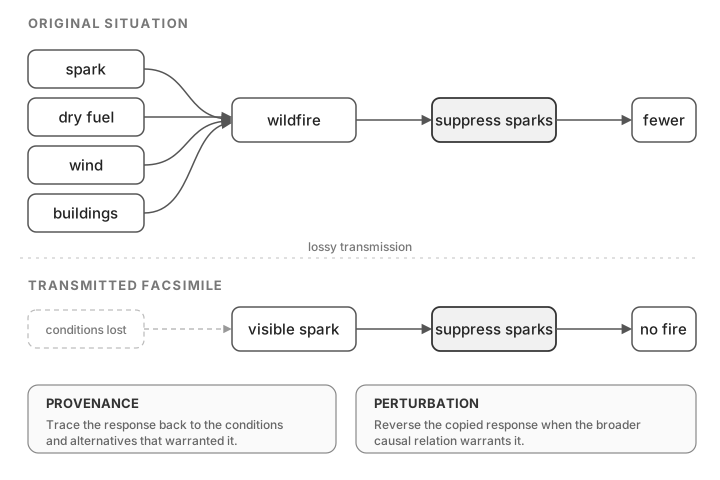
This compression is necessary because we cannot rediscover every action from first principles. It makes a facsimile response fast, transmissible, and often correct. Yet the same compression lets the response cross between agents more easily than its warrant. The visible sequence survives; the causal neighborhood disappears.
Other fields have named parts of this process:
| Field | Name | Meaning |
|---|---|---|
| Cognitive psychology | Negative analogical transfer | A solution follows surface resemblance when the causal structure differs. |
| Cultural learning | Overimitation | People copy even causally irrelevant parts of a successful action. |
| Organizational learning | Competency trap | Success concentrates practice in one routine and suppresses exploration. |
| Safety engineering | Normalization of deviance | Repeated survival turns an unresolved risk into acceptable practice. |
| Systems thinking | Fixes that fail | A successful short-term response changes the system and worsens the future problem. |
| Finance | Disaster myopia | A long absence of loss lowers the estimated probability of catastrophe. |
These are neighboring failures rather than synonyms. Facsimile response instead names the transmission step: an action survives as its warrant disappears.
A valid inheritance and a detached copy look alike until something perturbs them. Repeating the response supplies more evidence for it but no counterfactual, even though two fires may begin with the same spark while propagating through different causal paths. Ignition prevention can ignore that difference; remediation cannot.
response     → stop the present failure
recovery     → restore the previous state
remediation  → alter the next situation
Perturbation takes courage because the inherited response carries legitimacy. If it fails, the system failed; if a deviation fails, the person who tried it did. Institutions thus distribute the cost of obedience while concentrating the cost of learning.
History lets us borrow perturbations from people who varied what we cannot. A case study preserves the situation, alternatives, and consequences. By contrast, a positive example preserves only another response to copy. Borrowed experience is lossy too, so its value depends on provenance. Where did the response work, and under which conditions? Against which alternatives, and with what downstream effects? These questions matter because one life rarely contains enough variation to identify the causal relation.
Remediation therefore requires an abductive leap, because Bayesian updating cannot weigh a cause absent from the current hypothesis space. Abduction introduces one, although the new cause can sound like an accusation that earlier successes were misunderstood.
Some institutions therefore give that accusation a role. The Church required its Promoter of the Faith, the historical “devil’s advocate,” to object to canonization (Catholic Encyclopedia). After Columbia, an independent board likewise looked beyond the foam strike to schedule pressure, communication barriers, and reliance on past success. It judged NASA’s management practices as causal as the foam itself (CAIB report).
A broader graph remains only a story until tested. The National Park Service therefore measures plots before and after prescribed burns and uses untreated controls to separate fire effects from climate, moisture, and grazing (NPS Fire Monitoring Handbook). A useful perturbation asks:
What is the smallest action that could tell us this edge is wrong?
Acting opposite to the facsimile response requires a causal relation broad enough to justify the reversal. Suppress the spark when ignition is the danger. When accumulated fuel is the danger, cause one deliberately.