Computational Theology
Part of the cognition series. Builds on Consolidation Codec and cons.
The Trinity is the hardest doctrine in Christianity. Three persons, one God, no parts. The early church spent three centuries formalizing it, borrowing Greek philosophy — ousia, hypostasis, homoousios — because the available vocabulary couldn’t express what they were observing. Every formalization was an approximation. Every approximation spawned a heresy when taken too literally.
How we orient ourselves in relation to the universe is a different question from how dank the wine was. The miracles are the price of entry. The structure is the product. Once past the confessional gate, the intellectual work of theology is structural: how do three compose into one, what does directed asymmetry mean for personhood, what is simplicity in a triadic system. You don’t need to believe in the resurrection to evaluate the structure. A category theorist who’s never been to church can check whether the heresy mapping holds.
What if the vocabulary has improved?
Three kinds of knowing
Long-term memory comes in three kinds:
- Semantic: what is true. Facts, theories, domain knowledge.
- Procedural: how to act. Workflows, recipes, compiled skills.
- Episodic: what happened. War stories, experiences, outcomes.
These aren’t three stores that happen to coexist. In the Natural Framework, they’re three aspects of one system: what the system knows, what it does, and what it has lived through. They’re interdependent — each constrains and feeds the others. They’re distinct — they answer different questions. Collapse any two and you lose the third’s information.
Three interdependent, irreducible aspects of one thing. The pattern is old. The vocabulary is new.
The mapping
- God the Father = semantic memory. What is true. The ground of being. “I AM.” The unbegotten origin from which the others proceed.
- Jesus the Son = procedural memory. How to act. “I am the way.” The incarnation is God entering the world as executable procedure. “Follow me.” The Logos is not one procedure among many — it is the meta-procedure, the form that all doing must take.
- Holy Spirit = episodic memory. What is happening. Present with you in experience. “The Spirit searches all things” (1 Cor 2:10). Indwells. Witnesses. Bears testimony.
The relational pattern maps to the monoid:
Father begets Son: knowledge shapes procedures. smem → pmem.
Son sends Spirit: procedures generate experiences. pmem → epmem.
Spirit intercedes before Father: experiences consolidate into knowledge. epmem → smem.
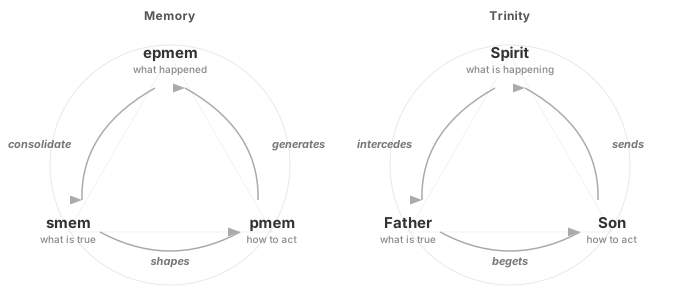
The third morphism is the hard one. Soar couldn’t build it. cons describes the structure. The Spirit-to-Father return — prayer, testimony, witness — is the consolidation loop that cognitive architectures struggle to close.
Description, not prescription
The scientific method does not prescribe a foreign way of thinking. It describes what learning already does when belief meets a world it cannot know in advance: form an expectation, act, observe, update. Boole did not invent the distinction between true and false; he gave its operations an algebra. Popper did not invent falsifiability; he named the boundary between a claim that can learn from the world and one that cannot. Better vocabulary makes a process legible. It does not invent the process.
This mapping makes the same move with agency. A person exists in time, carries an incomplete understanding, acts forward from it, and receives an outcome that changes what comes next. Tempus, doxa, praxis: time, belief, action. Semantic, procedural, and episodic memory name the three irreducible roles in that movement. Father, Son, and Spirit name the same form in the theological vocabulary we inherited.
I am not proposing that God is made of computation, or prescribing a new way to think. I am assigning more precise vocabulary to the roles, states, and transitions already available for a person to interpret and act in the world. The claim is stronger than resemblance but narrower than metaphysics: the Trinity is a coherent description of temporally bounded agency.
Faith is acceptance of that description. Not assent to a mechanism hidden behind the universe, but trust that truth, action, and experience belong to one process; that none can be discarded; and that a life becomes coherent by letting the whole loop run.
Heresies as structural errors
The early councils weren’t just arguing about words. They were rejecting specific structural errors:
- Arianism (Son is lesser than Father) = one projection is incomplete. A lossy projection that doesn’t preserve the full invariants. The council of Nicaea rejected this: the Son is consubstantial, not subordinate.
- Modalism (three masks, one person) = collapsing distinct projections into one. Three names for the same view. If semantic, procedural, and episodic memory are the same thing under different labels, you’ve lost the structural distinction.
- Tritheism (three separate gods) = three independent datasets. No shared journal. If the three memories don’t derive from one system, you don’t have a trinity — you have three unrelated stores.
- Pneumatomachianism (the Spirit is lesser than Father and Son) = mistaking a thin store for a dispensable one. Episodic memory holds less because its products are consolidated elsewhere, not because experience is subordinate to truth and action.
Each heresy rhymes with a structural error. The theological vocabulary names what went wrong; the structural vocabulary shows the shape of what went wrong.
This is where the mapping becomes more than analogy. An analogy notices a resemblance and stops. A description earns its keep by exposing failures. Collapse the roles and you get modalism. Separate them and you get tritheism. Rank them and you get Arianism or Pneumatomachianism. The structure makes the heresies predictable instead of merely memorizable.
The thin store
Episodic memory is thin by design. Consolidation absorbs its products: what an experience taught becomes semantic, what it trained becomes procedural, and the episode itself fades toward a stub. A healthy epmem can hold less precisely because it keeps giving its contents away.
That makes the Spirit easy to leave in the margins. The Father has doctrines. The Son has a life, teachings, and a procedure to follow. The Spirit has presence, witness, intercession — transitions whose products appear under other names once they land. But thin does not mean lesser. Without the episodic return, semantic and procedural memory form a closed loop, unfolding only what they already contain. The Spirit is where action encounters what is real and brings back what the system could not generate from itself.
A thousand years of prayer is introspection into this agentic computation. Prayer produces episodes; communities compare them; theology consolidates their recurring structure; doctrine preserves what survives. The Trinity is a warrant-preserving compression of that record. Its three persons keep the irreducible shape small enough to transmit.
Compression is not completion. Doctrine is the compressed artifact; a life is its unfolding. Reading unfolds the inherited record into present understanding. Prayer exposes the live state that record must meet. Action carries the interpretation forward, experience returns the result, and consolidation changes what the person next believes and does. None of these interfaces can substitute for another.
That is what faith accepts: not a finished answer to repeat, but a description to inhabit. The creed is the seed of a process each person must unfold again in time.
Prior art
Robinson & Southgate (2010) map Peirce’s triadic semiotics onto Trinitarian theology: Firstness/Secondness/Thirdness as Father/Son/Spirit. Robinson’s book God and the World of Signs develops this at length. The mapping here uses a different lens (cognitive architecture rather than Peircean semiotics) but lands on the same triangle. Lethen (2022) formalizes Trinitarian logic computationally using metaobject structures.
Written via the double loop.