Compensating Controls
An advertiser hands a platform money. The platform runs the ads, records the delivery, assigns itself credit for the sale, and reports the result. Four duties that accounting separates—execution, custody, recording, and authorization—sit with the same counterparty. The advertiser knows what he paid and what he sold, but holds no counterparty record joining the two. That is not a measurement problem. It is a segregation-of-duties failure with no source document to catch it. It is an accounting problem.
Accounting has a word for what happens next. A control is a check the books run on the business, like matching invoices to deliveries before paying them. When an auditor finds one missing, the client rarely fixes it, because fixing it means changing the system that everyone’s job depends on. Instead the client adds a compensating control, a second process that watches the gap the first one left open. Auditors accept compensating controls with a known caveat: they cost more than the control they substitute for, they degrade as the system changes, and they never quite close the gap.
That diagnosis makes two market predictions. On the demand side, advertisers should hire people to join exposure, purchase, and finance data into a result they can defend. On the supply side, media sellers should build closed-loop measurement as a product and reconciliation as financial infrastructure. Across both sides the specifications should converge: verified events, stable identifiers, explicit allocation rules, auditable lineage, and separate experiments for causation.
Keep three questions separate while reading it. Occurrence: did the delivery and conversion happen? Allocation: which channel gets the entry? Causation: would the sale have happened without the ad? Ordinary source documents answer the first two. Only an experiment can answer the third. Adtech bundles all three under measurement, which is how an accounting defect gets sold back as an analytics service.
The market falsifier
Start above the anecdotes. CIMM and the 4As surveyed 197 director-level brand marketers at companies spending at least $50 million a year on US marketing, then interviewed sixteen executives. They found attribution resting on stitched datasets and platform signals that were rarely transparent or independently validated. One executive called triangulating the competing sources daily manual work; another reconciled four or five versions of ROAS. Confidence was highest when events were direct and observable, and fell when systems had to be joined.
The survey also supplies a useful correction: advertisers are not asking for one source of truth. They are asking to see how different records relate, why they disagree, and whether the transformations can be inspected. A universal dashboard is not the product. Reconciliation is.
Now read the jobs. Keurig Dr Pepper’s Media Measurement Manager posting gives the sharpest demand-side specification I could find: verified exposure + verified sale = attributed sale, with no multi-touch model; harmonize retailer purchase records; document lineage; reconcile inventory, spend, and outcomes; run causal lift separately. The company is standing up a team to operate this daily and offers $96,800 to $143,000 for this role. Conagra offers up to $197,000 for a Director of Marketing Measurement to move measurement from vendors into an in-house or hybrid system spanning Marketing, Finance, Data Science, and Engineering.
The supply side already sells the solution where it can. Walmart Connect is hiring a Director of Data, Identity & Measurement Product Marketing to commercialize attribution, incrementality, clean rooms, and first-party measurement. Sam’s Club’s Performance Measurement and Insights team turns deterministic membership transactions into trusted measurement products for advertisers. An IAB study of 200 retail-media buyers found measurement and data collection their number-one opportunity; 62% named missing measurement standards as a top growth challenge and nearly 60% wanted more transparency.
Retail media is the positive control. Join exposure to a verified sale and advertisers move budget; Walmart advertises closed-loop measurement in the job description of the people who sell the ads. But the loop closes only because the retailer owns the ad surface, customer identity, and till. It is still grading its own homework.
The market has therefore validated a product shape, not this implementation: verified exposure, verified purchase, stable join, explicit credit rule, and auditable lineage, with causation tested separately. What remains unvalidated is the crucial adjective: independent. None of these employers asks for a cryptographic coupon, a public ledger, or a neutral settlement record. The open question is whether buyers will pay for counterparty evidence rather than accept a more convenient first-party claim.
The commercial stack is the second test. Where a buyer cannot match an order, a delivery, and a settled outcome, vendors should appear to reconstruct each leg from outside. Their combined bill should approximate the price of the missing control. The industry exists. Here is the inventory.
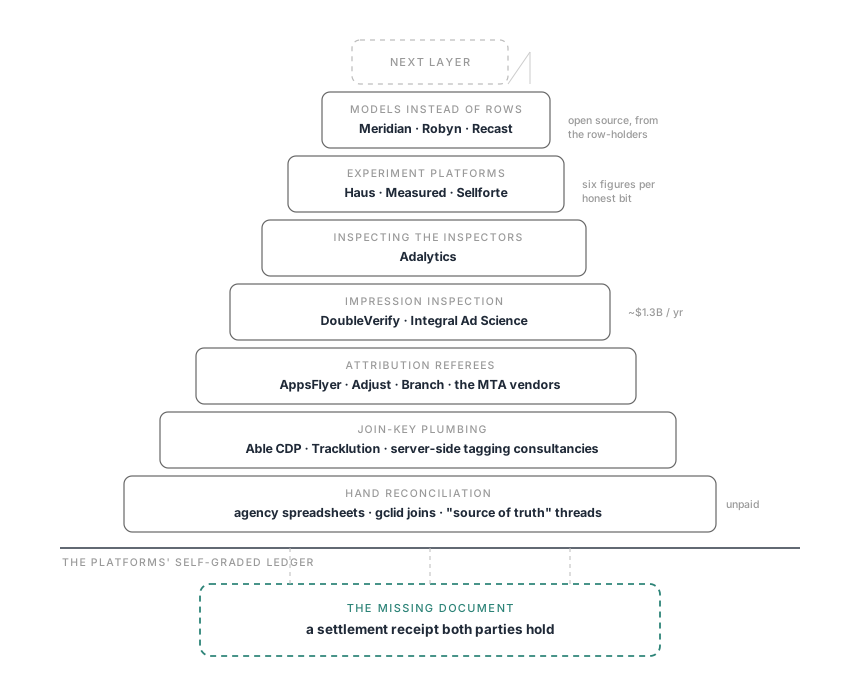
The stack
Different tiers repair different legs of the failed three-way match. What unites them is that the buyer cannot test the platform’s claim against a record produced independently of the platform.
Impression inspection. DoubleVerify and Integral Ad Science sell verification that ads were viewable, non-fraudulent, and brand-safe. Between them they bill roughly $1.3 billion a year (DV investor filings, IAS Q3 2025). The document they substitute for is a delivery record the buyer could check himself. A warehouse gets one with every pallet; it’s called a receiving report, and nobody pays a duopoly a billion dollars a year to guess whether the truck arrived.
Inspection of the inspectors. In March 2025 Adalytics published a 240-page report documenting ads served between 2019 and 2025 to bots that declared themselves as bots, in accounts paying for bot filtration. DoubleVerify disputes the findings. Whoever is right, note the layer’s existence: a forensic researcher auditing the verification vendors, one level up the same tower, substituting for the same missing document.
Attribution referees. Mobile measurement partners (AppsFlyer, Adjust, Branch) and the multi-touch attribution vendors exist because every platform attributes conversions to itself and the claims sum to more than the sales. The MMP is a privately hired referee for credit disputes. The document it substitutes for is a conversion record both counterparties sign: a settlement receipt.
Experiment platforms. Haus, Measured, Sellforte and their cohort sell geo-holdout experiments. A geographic split is the one experiment the platform cannot referee, because it runs in the world, outside the platform’s reporting. This tier is not a substitute for a receipt: it answers causation, which no receipt can answer. But its price rises when the experiment must first reconstruct a trustworthy outcome variable from disputed books.
Models instead of rows. Marketing mix modeling died with the spreadsheet era and came back after ATT. Google now ships Meridian and Meta ships Robyn, both open source. An MMM is legitimate causal machinery, but in adtech it is also forced to stand in for missing books. The two companies holding the row-level data give away tools for modeling around its absence.
Join-key plumbing. A cottage industry (Able CDP, Tracklution, and server-side tagging consultancies) exists to hand-carry the gclid from the click through the funnel to the charge, because the channel does not carry its own join key to settlement. WhatConverts can capture calls, forms, chats, and click identity, qualify the lead through rules, and return selected conversions to Google Ads. Ruler Analytics sends CRM stages and revenue events through the same feedback loop. These products perform a real control: they replace the raw form fill with a label closer to business value. But the usual direction remains inward. The advertiser improves its own outcome record and uploads it into the platform’s optimizer.
Unpaid reconciliation labor. Under the commercial layers sits the free one. Spend an hour in r/PPC’s archives and you find the same thread monthly: Meta says 374 leads, Google Ads says 71, GA4 says 110, whose number goes in the client report? The community does not consistently choose one truth. A common answer is to use platform figures for steering that platform, the CRM or backend for realized revenue, and analytics or a separate model for cross-channel reporting. Different instruments answer different questions; large or sudden disagreements still trigger debugging. The labor lies in maintaining those joins, explaining the differences, and deciding which record governs each decision.
The audits
The layers above are recurring, but twice the industry paid for the one-off version, an actual forensic reconciliation.
ISBA and PwC traced UK programmatic spend end to end in 2020: 12% of impressions could be matched from advertiser to publisher, and 15% of spend was an “unknown delta” attributable to no party. The 2022 restudy, after two years of data standardization, matched 58% and shrank the delta to 3%. Read that as good news, carefully. Reconciliation is achievable, but it took a trade body, PwC, and years of coordination, and it runs about twice a decade. Double-entry bookkeeping does the equivalent nightly.
The ANA’s 2023 study put numbers on the open-web pool: $88 billion in spend, $22 billion of it waste, and $0.36 of each DSP dollar reaching a consumer.
On the attribution side, Blake, Nosko and Tadelis switched off eBay’s brand-search ads and watched the traffic arrive anyway. Gordon et al. ran Meta’s own lift experiments against observational attribution and found the observational numbers overstated lift by multiples. eBay cut nine figures of spend; it was auditing its own books. The industry-level findings moved nothing, because an aggregate finding has no owner. Each study was absorbed as demand generation for the next layer of the stack.
The demolition
Suppose the conversion event carried its own proof: a settlement record that advertiser and channel both hold, generated at the moment the money moves, checkable without trusting either party. The croupier design is one construction; a payment processor countersigning the charge would be another. The construction is direct-response by design; brand advertising buys attention with no settlement event, and keeps its models.
Rerun the inventory against that record and the accounting half of the tower comes down. Under outcome-based settlement, no conversion claim needs a referee, no join key needs hand-carrying, no sheet needs reconciling, and the forensic audit that took PwC two years shrinks to a nightly batch job. Impression inspection still matters wherever impressions remain the billable good. It stops carrying the impossible burden of proving sales.
The causal half survives. A receipt proves occurrence and allocation: the conversion happened, cleared, and carried a valid claim from this channel. It does not prove the ad caused it. Geo-holdouts still answer the incrementality question, cheaper and higher-powered once the outcome variable stops being disputed. A receipt is bookkeeping, and no amount of bookkeeping substitutes for a counterfactual.
The diagnosis is a failed three-way match made durable by a segregation-of-duties failure. The compensating-control industry is real, and part of its labor reconstructs occurrence and allocation from records that were not designed to reconcile. That expenditure shows the problem has a price; it does not reveal what buyers would pay for a different control. The stack doesn’t need another claim to reconcile. It needs counterparty evidence.
Part of the Vector Space series.